
How to Teach Your Child Quran at Home: A Step-by-Step Guide for Parents
Teaching your child Quran at home works best in four steps: pick the right starting age, build a short daily routine, teach Arabic letters and Noorani Qaida before full recitation, then add Tajweed and memorization slowly. Fifteen to twenty focused minutes a day, done with warmth and patience, teaches more than long sessions that happen once a week.
Every Muslim parent asks the same question at some point. Where do I even start? You do not need a degree in Tajweed or a background in Arabic to teach your child Quran at home. You need a plan, a bit of daily time, and patience. This guide walks through age-by-age steps, a full lesson plan, and the tools that actually help. Start today, at your own pace.
If teaching your child Quran at home ever feels like more than one parent can carry alone, that is normal. Many families pair home lessons with structured online Quran classes for kids to keep pronunciation on track. You still handle the daily routine. The teacher handles the correction.
What Is the Right Age to Start Teaching Quran at Home?
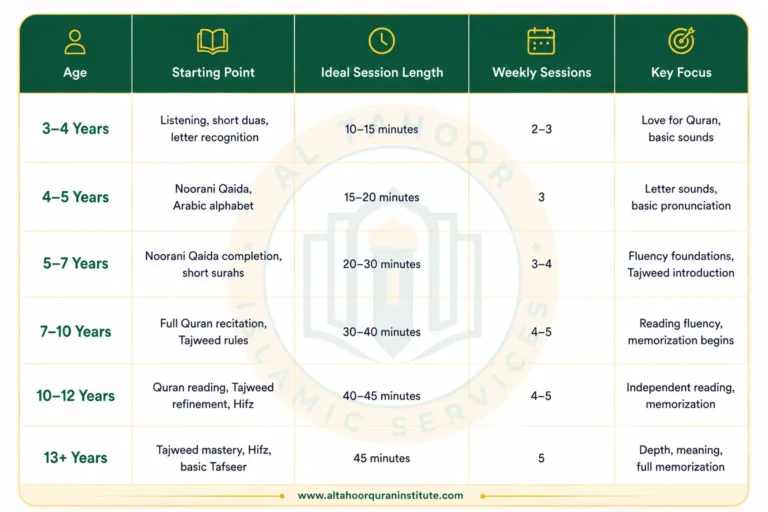
Most children are ready to begin around age four or five, once they can sit for a few minutes and repeat simple sounds. Readiness matters more than a fixed number. A child who listens and imitates words is ready, whatever their exact age.
Ages 3 to 5: Sounds, Letters, and Short Duas
Little ones do not need formal lessons. Say a few Arabic letters together, sing a short dua, or repeat a line from a short Surah. Keep it playful. Some children respond right away, others stay quiet and just absorb. Both are normal at this stage.
Ages 6 to 10: Reading, Short Surahs, and Islamic Values
This is when reading skills grow fast. Children start recognizing joined letters, reading short Surahs from Juz Amma, and connecting simple values like honesty and patience to daily life. Progress becomes visible, though pace still varies from child to child.
Ages 11 and Up: Meaning, Tajweed Depth, and Independence
Older children want to know why, not just how. This is the age to explain the meaning behind verses and tighten up Tajweed rules. Let them take more ownership of their own practice. For a deeper look at readiness signs by age, this guide on the best age to start Quran lessons for kids breaks it down further.
How Do You Set Up a Home Environment for Quran Learning?
A good learning space does not need to be fancy. It needs to be quiet, consistent, and free of distractions like phones or the TV playing in the background.
Pick one corner of your home for Quran time. A prayer mat, a Quran stand, and decent lighting are enough. Keep the Mushaf, Qaida book, and any flashcards within reach so you are not searching for materials mid-lesson.
Choose a fixed time each day, whether that is right after school, before dinner, or right after Fajr. Consistency beats duration. A calm fifteen minutes at the same time daily builds a habit faster than an hour squeezed in once a week. Turn off notifications and close the door if you can. Treat this time as protected, the same way you protect homework time or bedtime.
How Do You Teach the Arabic Alphabet and Noorani Qaida at Home?
Start with the twenty nine Arabic letters before opening the Quran itself. Noorani Qaida is the standard beginner book used worldwide for exactly this purpose. It works whether you teach it yourself or follow it alongside a tutor.
Introduce one or two letters per session using flashcards or a printed alphabet chart. Focus on correct articulation points, called Makharij, from the very first lesson. A letter learned wrong early is hard to unlearn later. Slow and correct beats fast and sloppy every time.
Once your child recognizes the letters, move to Harakat, the short vowel marks that change how a letter sounds. Sukoon comes next, the mark showing a letter has no vowel. Tanween and Madd, the elongation rules that shape Quranic rhythm, follow after that. Our Noorani Qaida course follows this exact sequence with a live teacher if you want backup at any stage.
Most children complete Noorani Qaida in three to eight months with daily fifteen minute sessions. Speed depends far less on the child’s intelligence than on how consistent the practice is.
How Do You Teach Tajweed and Correct Pronunciation to a Child?
Tajweed simply means reading the Quran with correct pronunciation and rhythm. You do not need to memorize every rule name to teach your child Quran at home with correct Tajweed. Model the sound first, let your child repeat it, then gently correct.
Break each rule into a single, small habit. Teach one Tajweed rule at a time, such as lengthening a Madd letter or softening a Qalqalah letter. Practice it inside a short verse until it feels natural. Piling on five rules in one sitting overwhelms most children and slows real progress.
Play recordings of a clear, well known reciter during quiet moments, in the car, or before bed. Children absorb rhythm and pronunciation just by hearing it repeated, even without a formal lesson attached. For a fuller breakdown of rules and practice drills, see this beginner’s guide to Tajweed.
If your own Tajweed needs polishing, learn alongside your child rather than waiting until you feel expert enough. Children pick up far more from watching a parent try, correct, and keep going than from a parent who waits for perfection.
What Is the Best Way to Teach Quran Memorization at Home?
Start memorization with the shortest Surahs, such as Al-Ikhlas, An-Nas, and Al-Falaq, before moving to longer ones. Break every Surah into single verses and repeat each one five to ten times before adding the next.
A steady, small daily target beats an ambitious one that burns out after a week. Younger children often manage one or two lines a day, while confident readers aged nine and up can often handle half a page. Revisit memorized verses weekly, since Quran memorization fades quickly without repetition, a process known as Muraja’ah.
Use a simple progress chart so your child can see how far they have come. Small, visible wins keep motivation high, especially with younger kids who love watching a chart fill up. Our free Quran learning tracker is built for exactly this and works whether you teach at home, use an app, or combine both. For a full memorization system with daily schedules by age, read our complete guide on how to memorize the Quran.
How Do You Make Quran Learning Fun for Kids?
Children learn faster when a lesson feels like play rather than a chore. Mix in stories, small rewards, and short games instead of pure repetition.
Tell age appropriate stories about the prophets and companions. A story about Prophet Yusuf teaches patience far better than a lecture on the word itself. Ask your child what they would have done in the same situation to turn listening into thinking.
Turn drills into games. Flashcard races, letter tracing in sand, and simple matching games keep young attention spans engaged. They work better than a plain worksheet ever will. Reward completed Surahs or chapters with small treats, stickers, or a call to grandparents to share the news. Praise effort as much as accuracy. A child who feels safe making mistakes tries harder than one who fears getting it wrong.
Our Islamic studies for kids program folds these same story-based and game-based methods into short weekly lessons. It is useful extra material if you want more than what you build at home.
What Tools and Resources Help Parents Teach Quran at Home?
The right mix of tools depends on your child’s age, your own Arabic level, and how much one-on-one correction your child needs. Below is a quick comparison of the most common options parents use.
| Tool or Resource | Best For | Strength | Limitation |
|---|---|---|---|
| Printed Noorani Qaida book | Ages 4–8, visual learners | Low cost, no screen time | No audio correction |
| Color-coded Mushaf | Tajweed practice, ages 7+ | Visual Tajweed cues | Needs some Tajweed knowledge already |
| Flashcards and posters | Letter recognition, ages 3–6 | Hands-on, repeatable | Needs an adult to run sessions |
| Quran learning apps | Daily practice reminders, all ages | Convenient, gamified | Cannot correct live pronunciation |
| Audio recordings by reciters | Passive listening, all ages | Builds rhythm and familiarity | Not a substitute for direct correction |
| One-on-one online tutor | Structured progress, all ages | Live correction, accountability | Requires scheduled time and a fee |
Most families get the best results from a blend, using books and flashcards for daily home practice while adding a live tutor for pronunciation checks every week or two. If you would rather skip building a curriculum from scratch, our Quran memorization course already includes structured plans by age and pace.
What Are the Most Common Mistakes Parents Make When Teaching Quran at Home?
A few patterns show up again and again in families who struggle to stay consistent.
- Rushing past the basics. Skipping Noorani Qaida or Makharij to get to “real” Quran reading faster feels efficient. It almost always creates pronunciation habits that are harder to fix later than they were to teach right the first time.
- Long, irregular sessions. An hour-long lesson once a week teaches less than fifteen minutes daily. Children forget what they do not repeat often.
- Comparing siblings or peers. Every child memorizes and reads at a different pace. Comparing progress to a cousin or classmate usually causes frustration rather than motivation.
- Treating mistakes as failures. A child who is corrected harshly starts avoiding the lesson altogether. Gentle, immediate correction works far better than criticism after the fact.
- No revision plan. Memorized verses fade within weeks without repetition. Build weekly review into the schedule from day one, not as an afterthought.
- Teaching without your own Tajweed check. Passing on a mispronunciation to a child means re-teaching it later is twice the work. A quick session with a qualified Quran tutor can confirm your own pronunciation before you start teaching it forward.
Teaching Quran at Home vs Online Quran Classes: Which Should You Choose?
Both paths can raise a child who reads and loves the Quran. The right choice usually comes down to your own Tajweed confidence, your available time, and how much live correction your child needs.
| Factor | Teaching at Home | Online Quran Classes |
|---|---|---|
| Cost | Low, mainly books and materials | Ongoing tuition fee |
| Pronunciation correction | Depends on parent’s own skill | Live correction from a certified teacher |
| Schedule flexibility | Fully flexible | Flexible within booked slots |
| Parent time commitment | High, daily involvement | Lower, teacher-led sessions |
| Structured curriculum | Parent must build or source one | Built-in, age-based curriculum |
| Best for | Parents confident in their own Tajweed | Families wanting certified correction and structure |
Many families do not choose one over the other. A common, effective approach uses home practice for daily repetition. It adds short live sessions, such as a free trial Quran class, for weekly correction and accountability. This combination keeps cost low while still catching pronunciation mistakes early. It is one of the simplest ways to teach your child Quran at home without carrying the whole load alone.
Sample Weekly Quran Lesson Plan for Kids at Home
Use this as a starting template and adjust the pace to your child’s age and attention span.
| Day | Focus | Duration |
|---|---|---|
| Monday | New letters or new verse | 15–20 minutes |
| Tuesday | Repetition and Tajweed correction | 15 minutes |
| Wednesday | Story time linked to the verse or Surah | 15 minutes |
| Thursday | Repetition and light quiz or game | 15 minutes |
| Friday | Listening practice with a reciter recording | 10–15 minutes |
| Saturday | Full weekly revision (Muraja’ah) | 20 minutes |
| Sunday | Rest day or light listening only | Optional |
Keep sessions short and end on a win, even a small one, so your child associates Quran time with a positive feeling rather than pressure.
How Do You Keep a Child Motivated and Consistent Over Time?
Motivation dips are normal, not a sign that something is wrong. What keeps most families consistent long term is visible progress, shared family practice, and realistic pacing.
Let your child see you read or listen to the Quran regularly. Children copy what they see far more than what they are told. A parent who recites daily, even briefly, teaches more by example than any lesson plan.
Celebrate milestones, not just the finish line. Finishing Noorani Qaida, memorizing a first Surah, or reading a full page without help are all worth marking. Even a sticker or a favorite meal works. When progress stalls, take a short break rather than pushing through frustration. A few calm days off usually restores enthusiasm faster than forcing another session.
Frequently Asked Questions
Most children are ready around age four or five, once they can sit briefly and repeat simple sounds. Readiness depends more on attention span than exact age.
Yes, but it helps to learn the basics alongside your child, especially correct Makharij and Tajweed. Many parents pair home practice with a certified tutor for pronunciation checks.
Fifteen to twenty minutes is enough for most children under ten. Short, consistent sessions beat long, irregular ones for both memorization and attention span.
The Arabic alphabet and Noorani Qaida come first. This builds correct letter recognition and pronunciation before a child opens the Quran itself.
Break Surahs into single verses, repeat each one several times, and revise weekly. Short Surahs from Juz Amma are the easiest starting point.
Both work well. Many families combine daily home practice with weekly online sessions for live pronunciation correction and structure.
Dips in motivation are normal. Shorten sessions temporarily, add a story or game, and avoid pressure. Interest usually returns within a few days.
Learn one rule at a time alongside your child. Use recordings from a clear reciter as a model. Consider a periodic check-in with a certified Quran teacher.
Final Thoughts: Your Next Step
Teaching your child Quran at home is not about getting everything right from day one. It is about showing up, staying consistent, and adjusting as your child grows. Start with fifteen minutes today. Pick one letter, one dua, or one verse, and build from there.
If you have read this far, you already have what it takes to teach your child Quran at home. Priority one: fix a daily time, even fifteen minutes. Priority two: start with Noorani Qaida before full recitation. Priority three: add a weekly check-in, whether that is your own review or a free trial Quran class with a certified teacher. Guided sessions can complement what you are already building at home, without replacing it.