
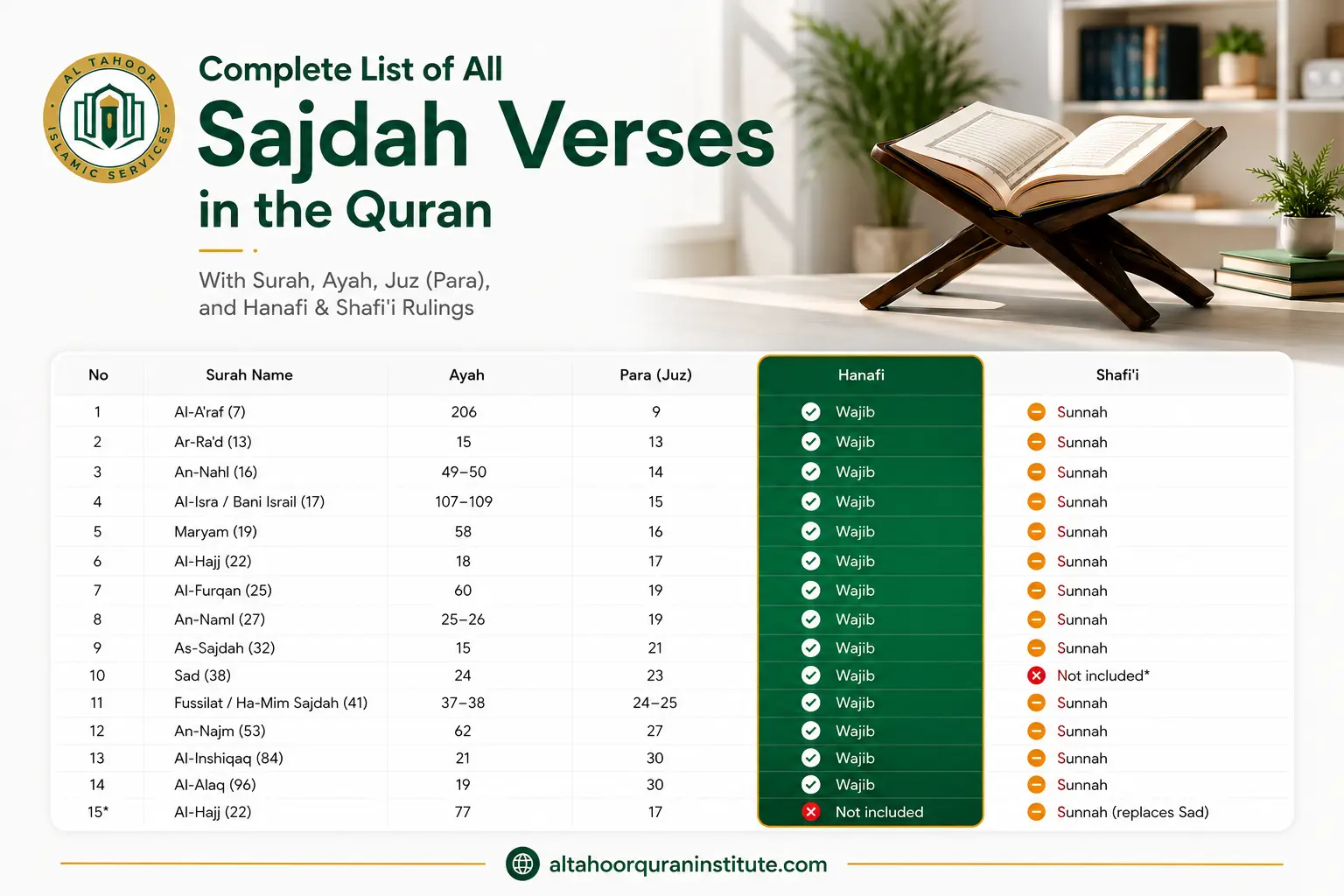
Sajdah in the Quran: Complete Guide to Every Verse of Prostration
You are reciting the Quran and the ayah ends with a special mark. Your teacher tells you to stop and make Sajdah. But why? Which verses need it? And how exactly do you perform it without making a mistake? This guide answers every one of those questions. Sajdah in the Quran is one of the most spiritually powerful acts in Islamic worship, and every Muslim who reads the Quran regularly needs to understand it completely.
This article covers the complete list of all 14 (or 15) ayat e sajda in the Quran, how to perform Sajdah Tilawat step by step, the dua to recite, rulings across all four major schools of thought, and answers to the most-asked questions on this topic. Whether you follow Hanafi, Shafi’i, Maliki, or Hanbali fiqh, you will find clear guidance here.
How Many Sajdah Are in the Quran?
There are 14 agreed-upon sajdah verses in the Quran, with a 15th discussed by some schools. Hanafi: 14 (all obligatory/Wajib). Shafi’i: 14 (recommended/Mustahab, different list). Maliki: 11. Hanbali: 15. All these are called Ayat al-Sajdah, and the prostration performed is called Sajdah Tilawat.
What Is Sajdah in the Quran? (Ayat al-Sajdah Explained)
Sajdah (Arabic: سجدة) means prostration — the act of placing your forehead on the ground in complete submission to Allah. In Islamic worship, it is the highest physical expression of humility before your Creator.
The Quran contains specific verses called Ayat al-Sajdah (آيات السجدة) — verses of prostration. When a reciter reaches one of these verses, they pause and perform a single prostration outside the normal units of Salah. This act is known as Sajdah Tilawat (سجدة التلاوة) — the Prostration of Recitation.
Allah (سُبْحَانَهُ وَتَعَالَىٰ ) says in the Quran (Surah Al-A’raf, 7:206): “Indeed, those who are near your Lord are not prevented by arrogance from His worship, and they exalt Him, and to Him they prostrate.” This verse is itself the first of the sajdah verses — meaning reciting it calls you to bow your forehead in the same act of worship it describes.
Sajdah Tilawat vs. Sajdah in Salah
These are two separate acts and should not be confused:
- Sajdah in Salah: Performed twice in every Raka’ah (unit of prayer). Total: 34 obligatory Sujood per day across the five daily prayers.
- Sajdah Tilawat: Performed upon reciting or hearing specific Quranic verses. It is a single prostration. It does not require the structure of full prayer.
The Prophet (ﷺ) said: “The closest that a servant is to his Lord is when he is prostrating, so increase in supplication during Sujood.” (Sahih Muslim, 482). Every time you perform Sajdah Tilawat, you step into that closeness.
Complete List of All Sajdah Verses in the Quran (With Para & Surah Numbers)
Below is the definitive list of sajdah in the Quran with surah name, ayah number, and Juz (Para) reference. This table covers both Hanafi and Shafi’i positions so you can apply the correct ruling for your madhab.
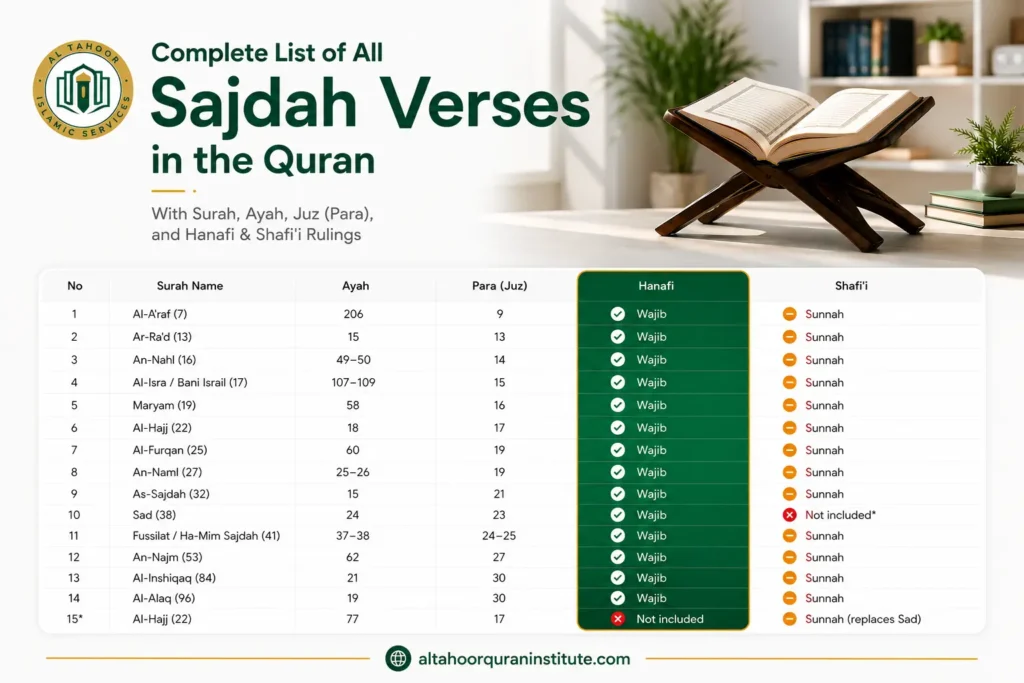
* Note on Surah Sad (38:24) and Hajj (22:77): The 15th position (Hajj 22:77) is included by the Shafi’i school in place of Surah Sad. In the Hanafi view, Surah Sad’s sajdah is Wajib while Hajj 22:77 is not a sajdah tilawat. See the school-by-school breakdown below.
Sajdah Verses Para-Wise: In Which Para of the Quran?
Many students ask: in which para is each sajdah? Here is a quick para-wise reference:
- Para 9: First sajdah — Surah Al-A’raf 7:206. The angels who never tire of worshipping Allah are described here.
- Para 13: Second sajdah — Surah Ar-Ra’d 13:15. All creation in the heavens and earth prostrates to Allah, willingly or unwillingly.
- Para 14: Third sajdah — Surah An-Nahl 16:49-50. Everything that moves and every angel prostrates to Allah without pride.
- Para 15: Fourth sajdah — Surah Al-Isra (Bani Israil) 17:107-109. Scholars and the knowledgeable weep and fall in prostration when the Quran is recited.
- Para 16: Fifth sajdah — Surah Maryam 19:58. The prophets and righteous would fall prostrate and weeping when they heard Allah’s words.
- Para 17: Sixth sajdah — Surah Al-Hajj 22:18. Everything in creation prostrates to Allah. (Second in Al-Hajj: 22:77, counted by Shafi’is.)
- Para 19: Seventh sajdah — Surah Al-Furqan 25:60. The disbelievers asked mockingly who is the Most Merciful. Believers respond with prostration.
- Para 19: Eighth sajdah — Surah An-Naml 27:25-26. Sulayman (عليه السلام) learns that the people of Sheba prostrate to the sun, not to Allah.
- Para 21: Ninth sajdah — Surah As-Sajdah 32:15. True believers prostrate at the reminder of their Lord and glorify His praises.
- Para 23: Tenth sajdah — Surah Sad 38:24. Prophet Dawood (عليه السلام) prostrated in repentance, and Allah forgave him.
- Para 24-25: Eleventh sajdah — Surah Fussilat (Ha-Mim Sajdah) 41:37-38. Do not prostrate to the sun or moon — prostrate to Allah who created them.
- Para 27: Twelfth sajdah — Surah An-Najm 53:62. Fall in prostration and worship Allah.
- Para 30: Thirteenth sajdah — Surah Al-Inshiqaq 84:21. When the Quran is recited to them, why do they not prostrate?
- Para 30: Fourteenth sajdah — Surah Al-Alaq 96:19. Do not obey him; prostrate and draw near to Allah. (Final sajdah in the Quran.)
How Many Sajdah Are in the Quran: 14 or 15? (Scholar Debate Resolved)
This is one of the most-searched questions about this topic. The short answer: it depends on your school of Islamic jurisprudence (Madhab).
| School (Madhab) | No. of Sajdahs | Ruling | Key Difference |
|---|---|---|---|
| Hanafi | 14 | Wajib (Obligatory) | Includes Surah Sad; excludes Hajj 22:77 |
| Shafi’i | 14 | Mustahab (Recommended) | Excludes Surah Sad; includes Hajj 22:77 |
| Maliki | 11 | Sunnah (Voluntary) | Excludes Hajj, An-Najm, Inshiqaq, Al-Alaq |
| Hanbali | 15 | Sunnah (Voluntary) | Includes all 15 locations |
The key difference between Hanafi and Shafi’i positions lies in two specific surahs. The Hanafi school includes Surah Sad 38:24 because Dawood (عليه السلام) performed prostration there. The Shafi’i school treats that as a Sajdah of Gratitude (Sajdah Shukr), not Sajdah Tilawat, and instead includes Surah Al-Hajj 22:77 as the 14th. Maliki scholars apply stricter criteria, accepting only 11. Hanbali scholars recognize all 15.
All four schools agree that performing these prostrations is an honored act of worship that draws you closer to Allah. The debate is about obligation, not spiritual value.
How Many Sajdah in Quran?
There are 14 sajdah verses agreed upon by most scholars (Hanafi and Shafi’i), though the specific verses differ slightly between them. Hanbali scholars count 15, and Maliki scholars count 11. All are called Ayat al-Sajdah, and the prostration performed is called Sajdah Tilawat.
How to Perform Sajdah Tilawat: Step-by-Step Guide
Whether you encounter a sajdah verse inside Salah or outside it, the method is clear and simple. Here is how to perform Sajdah Tilawat correctly:
| Step | Action |
|---|---|
| 1 | Make sure you have Wudu (ritual purification) — required by Hanafi; strongly recommended by all schools. |
| 2 | Face the Qibla (direction of the Kaaba in Makkah). |
| 3 | From a standing or sitting position, say Allahu Akbar without raising your hands. |
| 4 | Lower yourself into a single Sujud (prostration) with forehead, nose, both palms, knees, and toes touching the ground. |
| 5 | Recite the Dua of Sajdah Tilawat at least once (see Dua section below). |
| 6 | Rise from Sujud saying Allahu Akbar. No Tasleem (salaam) is needed when performed outside Salah. |
How to Perform Sajdah Tilawat Inside Salah
When you are praying and recite a sajdah verse in your Qira’at (recitation), you must perform the Sajdah immediately within the Salah itself. Do not skip it and continue. Here is what to do:
- Complete the full ayah of Sajdah.
- Say Allahu Akbar and go directly into Sujud (prostration position).
- Recite the dua in Sujud.
- Rise from Sujud saying Allahu Akbar.
- Stand upright again. Do NOT recite Bismillah before continuing your recitation.
Important: If the same sajdah verse is repeated several times within a single sitting or Salah, only one prostration is needed for each repetition. Repeating the same ayah does not require a new prostration unless you end your sitting and return.
Sajdah Tilawat When Listening to a Recitation
If you are listening to someone recite a sajdah verse live — in a masjid, in a gathering, or during a lesson — you are also required to perform Sajdah Tilawat according to the Hanafi school. The listener and the reciter both perform it.
However, if you are listening to a recorded recitation (audio file, YouTube, Quran app, radio broadcast, phone recording), the classical scholarly opinion is that Sajdah is not required. This is because a recording is not a live recitation. Shaykh Ibn Baz (rahimahullah) explicitly stated that Sajdah Tilawat is not prescribed when listening to a recording.
Dua of Sajdah Tilawat: Arabic Text, Transliteration & Meaning
The Prophet (ﷺ) used to recite a specific supplication during Sajdah Tilawat. Aisha (رضي الله عنها) narrated this dua, reported in Al-Hakim (1/220).
سَجَدَ وَجْهِيَ لِلَّذِي خَلَقَهُ، وَشَقَّ سَمْعَهُ وَبَصَرَهُ، بِحَوْلِهِ وَقُوَّتِهِ، فَتَبَارَكَ اللَّهُ أَحْسَنُ الْخَالِقِينَ
Transliteration
Sajada wajhiya lilladhi khalaqahu, wa shaqqa sam’ahu wa basarahu, bi hawlihi wa quwwatihi, fatabarakallahu ahsanul khaliqeen.
English Meaning
My face has prostrated to the One Who created it, and Who formed its hearing and its sight through His power and His strength. So blessed is Allah, the Best of Creators.
Second Dua (Narrated in Sunan Abu Dawud)
There is a second dua transmitted from the Prophet (ﷺ), narrated on the authority of Ibn Abbas (رضي الله عنه):
Arabic
اَللّٰهُمَّ اكْتُبْ لِيْ بِهَا عِنْدَكَ أَجْرًا، وَضَعْ عَنِّيْ بِهَا وِزْرًا، وَاجْعَلْهَا لِيْ عِنْدَكَ ذُخْرًا، وَتَقَبَّلْهَا مِنِّيْ كَمَا تَقَبَّلْتَهَا مِنْ عَبْدِكَ دَاوُدَ
Meaning
O Allah, record for me a reward for it with You, remove a sin from me by it, store it as a treasure for me with You, and accept it from me as You accepted it from Your servant Dawood.
You may recite either of these duas, or both, during the Sujud of Tilawat. At minimum, reciting Subhana Rabbiyal A’la three times is acceptable.
Conditions and Rules of Sajdah Tilawat: What You Must Know
Is Wudu Required for Sajdah Tilawat?
This is a commonly debated question. Here is the position by school:
- Hanafi: Wudu is a strict condition (Shart). Sajdah Tilawat is considered an act of worship similar to Salah and requires ritual purity. If you are not in a state of wudu when you recite or hear the verse, you must make wudu first and perform the sajdah later. It counts as a debt on you until performed.
- Shafi’i: Wudu is strongly recommended but not a strict condition. Some scholars within this school allow it without wudu, as it is classified as a voluntary act (Sunnah), not Salah.
- Maliki: Wudu is recommended.
- Hanbali: Wudu is desirable but not obligatory. It may be performed without wudu if needed.
Best practice: Always perform Sajdah Tilawat with wudu. This combines respect for the Quran’s command with proper Islamic etiquette and earns the maximum reward.
Is Sajdah Tilawat Obligatory or Sunnah?
The four schools disagree clearly here:
- Hanafi: Wajib (obligatory). Missing it intentionally is a sin. It is treated as a debt that must be repaid.
- Shafi’i & Maliki: Sunnah Mu’akkadah (confirmed sunnah). No sin if missed, but reward is great when performed.
- Hanbali: Sunnah. The stronger opinion in this school is that it is not obligatory.
Evidence for both sides: The Prophet (ﷺ) sometimes recited these verses without prostrating (as Umar ibn al-Khattab رضي الله عنه narrated), which scholars use to argue it is not obligatory. However, the Hanafi school responds that this was done to teach people that it is not a pillar of Salah, not to cancel its Wujub.
Can Women Perform Sajdah Tilawat During Menstruation?
No. A woman in a state of Haidh (menstruation) or Nifas (postnatal bleeding) is exempt from Sajdah Tilawat. According to the Hanafi school, she is not required to make it up afterward, since its obligation depends on the ability to perform it at the time. This is the position of the majority of scholars.
When Are Sajdah Times Prohibited?
In the Hanafi school, Sajdah Tilawat is prohibited during three makruh (disliked) times:
- At sunrise (the moment the sun is rising).
- At exact midday (zawal — when the sun is at its zenith).
- At sunset (the moment the sun sets).
If you encounter a sajdah verse during these times, wait until they pass, then perform the prostration.
What If You Miss a Sajdah Tilawat?
In the Hanafi school, a missed Sajdah Tilawat remains a debt that must be fulfilled. You can perform it later at any valid time. In other schools, since it is a sunnah, missing it carries no sin, though you should perform it as soon as possible after the moment passes.
Want to Read the Quran Correctly — Including Every Sajdah?
Book a Free Trial Class at Al Tahoor Quran InstituteSpiritual Significance of Sajdah Tilawat: Why Does It Make Shaytan Weep?
This is one of the most moving aspects of Sajdah Tilawat. There is a powerful hadith that captures its spiritual weight:
Hadith of Shaytan’s Weeping (Sahih Muslim)
“When the son of Adam recites a verse of Sajdah and then falls in prostration, Shaytan withdraws weeping and says: Woe to me! The son of Adam was commanded to prostrate, and he did so, and Paradise was his reward. I was commanded to prostrate, and I refused — I am destined for the Fire.” — Sahih Muslim
Every time you lower your forehead to the ground at an ayah of Sajdah, you are doing what Shaytan refused to do. This act re-enacts the covenant of submission. It is a direct rebuke to arrogance — the very sin that cast Iblis from the mercy of Allah.
Benefits of Performing Sajdah Tilawat
- Brings you to the closest possible state to your Lord — the Sujud position.
- Purifies the heart from pride and arrogance.
- Increases reward with each prostration recorded by the angels.
- Fulfills a divine command embedded within Allah’s own speech.
- Demonstrates obedience to the Quran in real time — not just reading, but acting.
- Creates a spiritual pause that breaks the mechanical habit of recitation and restores presence.
The scholars say: “Every verse that mentions the greatness of Allah and the humbleness of the servant — at that point, prostration of recitation becomes a means of drawing close to Allah for the reciter.”
The Meaning Behind Each Sajdah Verse — Why These Specific Ayat?
Each sajdah verse in the Quran was not placed randomly. Every one of them arrives at a moment of profound theological statement — a declaration of Allah’s greatness, a description of creation’s submission, or a story of a prophet bowing in worship. Here are some of the most significant:
Surah Al-A’raf 7:206 — The Angels Never Tire
The angels who are closest to Allah never become arrogant about worshipping Him. They glorify Him and fall in prostration. When you perform Sajdah here, you join the eternal worship of the angels in a moment of pure solidarity.
Surah Ar-Ra’d 13:15 — All Creation Prostrates
Everything in the heavens and the earth prostrates to Allah, willingly or by compulsion — and so do their shadows at dawn and dusk. You are part of that universal act of submission. When you bow your head here, the entire created order echoes your movement.
Surah Maryam 19:58 — The Weeping of the Prophets
When the Quran was recited to the prophets and righteous servants, they would fall prostrate, weeping. Performing Sajdah at this ayah is a direct imitation of the Anbiya — one of the most honored acts a believer can do.
Surah As-Sajdah 32:15 — The Mark of True Believers
True believers are described as those who fall in Sujud when reminded of Allah and who do not persist in arrogance. Performing Sajdah here is not just an act of worship. It is you fulfilling the description of a mu’min (true believer) in real time.
H3 | Surah Al-Alaq 96:19 — The Final Command
The last sajdah verse in the Quran. It is the final instruction from the first complete revelation: do not obey the enemy, and prostrate to your Lord. It is a fitting close — the Quran’s last call to Sujud is found in its very first revealed surah.
Common Mistakes Muslims Make With Sajdah Tilawat
Skipping Sajdah Tilawat in Hifz Practice
This is one of the most widespread issues. Students memorizing the Quran recite dozens of sajdah verses daily — often without performing the prostration. In the Hanafi school, every one of those becomes an outstanding debt. Scholars advise: keep track and pay them back systematically.
Performing Sajdah Without Wudu
Some Muslims perform Sajdah Tilawat out of habit without checking their state of purity. If you follow the Hanafi madhab, this is invalid. You must have wudu or make it up later when you have wudu.
Performing Sajdah for Recorded Recitations
Many Muslims mistakenly think they need to make Sajdah when a Quran app or audio recording passes a sajdah verse. As mentioned above, the majority of scholars hold that this is not required, since a recording is not a live recitation.
Raising Hands When Going into Sajdah Tilawat
Unlike the opening Takbir of Salah, you do not raise your hands to your ears when saying Allahu Akbar for Sajdah Tilawat. This is a common confusion. Keep your hands at your sides as you lower into Sujud.
Saying Tasleem (Salaam) After Sajdah Tilawat Outside Salah
Sajdah Tilawat performed outside of Salah does not end with Tasleem (As-salamu alaykum). You simply rise from Sujud and continue. No Salam is needed.
Learning Sajdah Tilawat Rules: Guidance for Muslims in the US, UK, Canada & Australia
For Muslims living in the West — whether in the United States, United Kingdom, Canada, or Australia — Quranic education sometimes comes with unique challenges. Masjids are not always nearby. Qualified teachers are not always available locally. And the rules around Sajdah Tilawat are rarely taught explicitly in weekend Islamic school.
This matters practically. A parent in London teaching their child Quran at home needs to know when to pause for Sajdah. A student memorizing Quran in Toronto needs to know if their daily recitation during Hifz requires Sujud. A new Muslim in Sydney who just began reading the Quran needs to understand why their teacher stops mid-recitation and bows their head.
Getting proper guidance from a qualified teacher — one trained in Tajweed, Fiqh, and Quran recitation — makes all the difference.
Al Tahoor Quran Institute: Certified Teachers for Students in US, UK, Canada & Australia
Start Learning With a Free Trial — Flexible Times, Any Time Zone
Why Is Surah As-Sajdah Named After Prostration?
Surah As-Sajdah (Chapter 32) is one of the few Quranic surahs named directly after an act of worship. It takes its name from verse 15, which describes the believers who never grow arrogant — they fall in prostration when reminded of their Lord and glorify His praises without pride.
The Prophet (ﷺ) used to recite Surah As-Sajdah in the Fajr prayer of Fridays, along with Surah Al-Insan. This is a confirmed Sunnah narrated in both Bukhari and Muslim. When performing this recitation in Salah, the Sajdah at verse 32:15 must be performed within the prayer itself.
This surah also contains powerful descriptions of the creation of the human being from clay, the reality of the Hereafter, and the distinction between those who die as believers and those who do not. It is a surah worth studying deeply beyond just its sajdah verse.
Continue Deepening Your Quranic Knowledge
Understanding Sajdah Tilawat is one part of a much richer journey through the Quran. Here are related topics that will help you build on what you have learned:
- Learn the rules of Tajweed and correct Quran recitation to recite every verse — including Sajdah verses — with precision.
- Understand the steps of Wudu in order so you are always ready to perform Sajdah Tilawat correctly.
- Begin your child’s Quran journey with kids online Quran classes that cover Tajweed, Hifz, and the rules of recitation from the start.
- Explore Quran Tafseer online to understand the meaning behind every Sajdah verse and why Allah placed it there.
- If you are memorizing the Quran, join a structured online Quran memorization course that teaches you to track and perform every Sajdah Tilawat as you go.
- For adult learners starting fresh, online Quran classes for adults offer one-on-one guidance with certified teachers at any skill level.
Frequently Asked Questions About Sajdah in the Quran
Q1: How many Sajdah are in the Quran?
There are 14 sajdah verses agreed upon by the Hanafi and Shafi’i schools (though the specific list differs slightly). The Hanbali school counts 15, and the Maliki school counts 11. All are called Ayat al-Sajdah, and the act of prostrating upon them is Sajdah Tilawat.
Q2: Is Sajdah Tilawat obligatory or optional?
It depends on your madhab. In the Hanafi school, it is Wajib (obligatory). In the Shafi’i, Maliki, and Hanbali schools, it is a Sunnah. All schools agree it is a highly rewarded act of worship.
Q3: Do I need Wudu to perform Sajdah Tilawat?
Yes, in the Hanafi school Wudu is required. It is also strongly recommended in all other schools. If you recite a sajdah verse without Wudu, make Wudu and perform the Sajdah later.
Q4: What do I say in Sajdah Tilawat?
The Prophetic dua is: “Sajada wajhiya lilladhi khalaqahu, wa shaqqa sam’ahu wa basarahu, bi hawlihi wa quwwatihi, fatabarakallahu ahsanul khaliqeen.” At minimum, say Subhana Rabbiyal A’la three times.
Q5: Do I need to perform Sajdah Tilawat when listening to a Quran recording?
No. The majority of scholars hold that recorded recitations do not trigger Sajdah Tilawat. This applies to audio files, apps, YouTube, and radio broadcasts. Sajdah Tilawat applies to live recitation only.
Q6: Which para has the most Sajdah verses?
Para 30 contains two sajdah verses: Surah Al-Inshiqaq (84:21) and Surah Al-Alaq (96:19). Para 19 also contains two: Surah Al-Furqan (25:60) and Surah An-Naml (27:25). Surah Al-Hajj has two verses with sajdah commands (22:18 and 22:77), though the two schools differ on which one to count.
Q7: Can I perform Sajdah Tilawat while sitting?
Yes. You may perform Sajdah Tilawat from either a standing or sitting position. The key is to go into full Sujud (prostration on the ground). If you are physically unable to prostrate fully, the ruling follows the same accommodations as Salah.
Q8: What if I missed many Sajdah Tilawat during Hifz practice?
In the Hanafi school, they remain as obligations to be fulfilled. You can perform them systematically — count the missed ones and make up a session of prostrations. Scholars say it is better to make them up as soon as possible, rather than letting the debt accumulate.
Q9: Is there a Sajdah in Surah Al-Hajj, and why are there two?
Yes. Surah Al-Hajj is unique in that it contains two potential sajdah positions: verse 18 and verse 77. The Hanafi school counts only 22:18. The Shafi’i school counts 22:77. Some Hanbali scholars count both, making Al-Hajj the only surah with two Sajdah Tilawat positions in their counting.
Q10: What is the difference between Sajdah Tilawat and Sajdah Shukr?
Sajdah Tilawat is a prostration triggered by a specific Quranic verse during recitation. Sajdah Shukr (prostration of gratitude) is performed upon receiving a great blessing or being saved from a harm. Both involve a single Sujud, but they are triggered by different circumstances. Surah Sad 38:24 is classified as Sajdah Shukr by the Shafi’i school because it describes Dawood (AS) prostrating in gratitude after his test.
Conclusion: Make Every Sajdah Verse Count
Sajdah in the Quran is not just a ritual interruption in your recitation. It is a divine invitation. At 14 specific moments across the Quran, Allah placed a verse that calls you — by the power of its own words — to lower your forehead to the earth. Each one arrives at a moment of maximum spiritual intensity: when creation’s submission is described, when a prophet weeps in prostration, when the disbelievers’ arrogance is contrasted with the believers’ humility.
Knowing the complete list of all sajdah verses, understanding how to perform each one correctly, and knowing the ruling of your madhab turns every recitation session into an act of complete, embodied worship.
Whether you are a student beginning Noorani Qaida, a Hafiz deep in your memorization, or an adult reciting the Quran for the first time — every sajdah verse you reach is a moment to choose submission over arrogance. Make that choice every time.
Next step: If you want to recite the Quran correctly — including knowing how and when to perform every Sajdah Tilawat — the most effective way is to learn with a qualified, certified teacher. Al Tahoor Quran Institute offers one-on-one online Quran classes with experienced teachers for students of all levels, all ages, and all time zones. Your first class is free.