Sayyidul Istighfar: The Complete Dua for Forgiveness in Arabic, With Meaning and Benefits
Every Muslim searches for words that truly reach Allah. Sayyidul istighfar is one dua that does exactly that. The Prophet Muhammad ﷺ called it the best way to ask Allah for forgiveness, and he taught it himself. It is recorded word for word in Sahih al-Bukhari.
This guide gives you the complete sayyidul istighfar dua in Arabic, its transliteration, and its English meaning. You will also learn the hadith behind it, when to recite it, how many times, and the mistakes most people make. We break down every phrase so you understand exactly what you are saying, not just how to say it.
Whether you already know this dua or you are learning it for the first time, this page covers everything you need in one place.
What Is Sayyidul Istighfar? (Meaning and Origin)
Sayyidul istighfar comes from two Arabic words. Sayyid means master, chief, or leader. Istighfar means seeking forgiveness from Allah. Put together, sayyidul istighfar means “the master of seeking forgiveness.”
This is not a title scholars invented later. The Prophet Muhammad ﷺ used this exact description himself, calling it the most superior way to ask Allah for pardon. That statement is preserved word for word in Sahih al-Bukhari.
Other spellings of the same dua include syed ul istighfar and sayyid al istighfar. All three point to the identical seven-line supplication.
What earns it the title “master” is its structure. In a few short lines, it declares Allah’s oneness, admits human weakness, acknowledges His blessings, confesses sin, and asks for forgiveness. Understanding the Arabic roots behind duas like this one becomes far easier once you can read and recognize the language itself, which is exactly what structured Arabic classes online are built to teach.
Sayyidul Istighfar in Arabic (Full Text, Transliteration, and Translation)
Below is the complete sayyidul istighfar dua exactly as recorded in Sahih al-Bukhari, Hadith 6306. Read the Arabic first if you can, then use the transliteration to check your pronunciation.
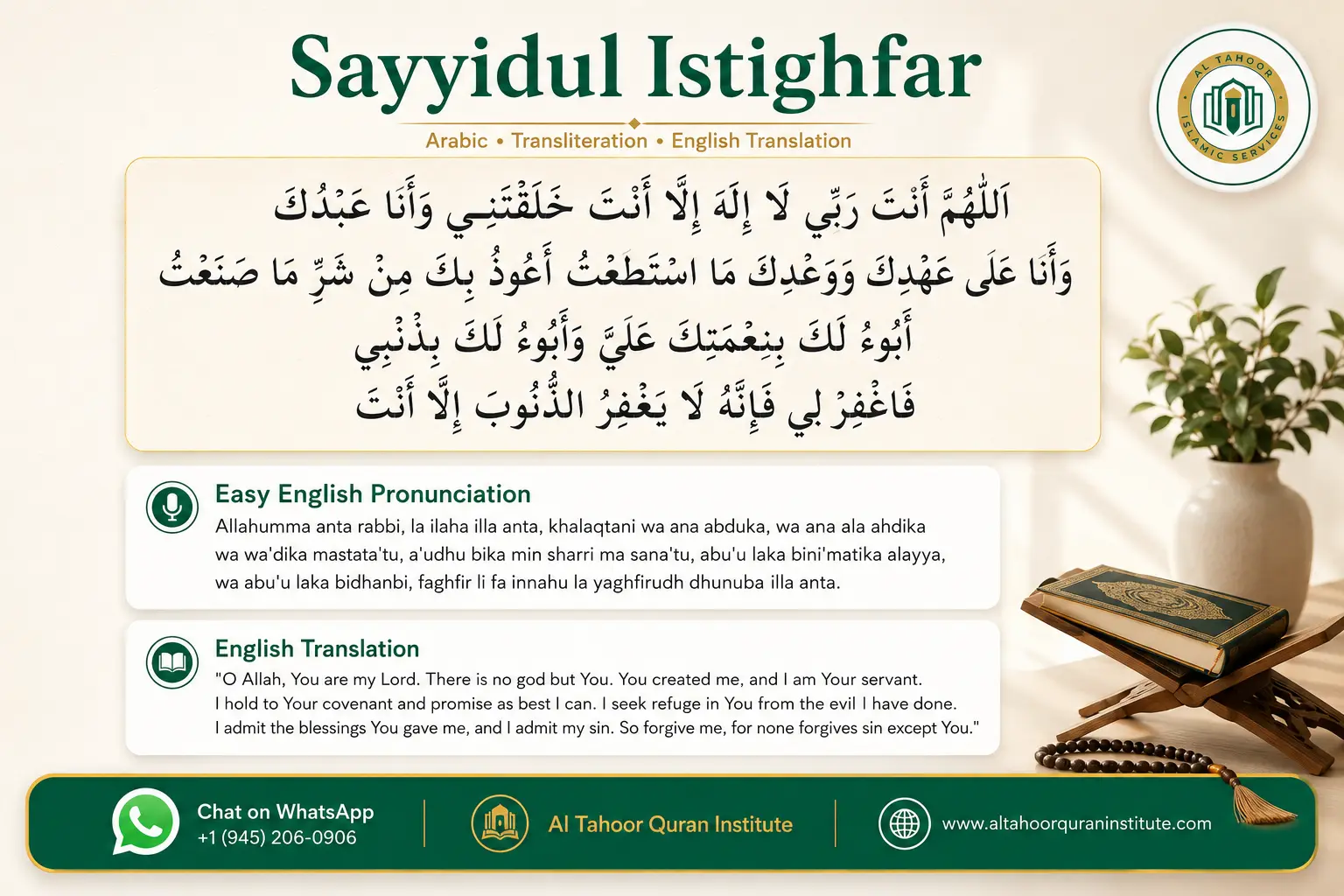
اللَّهُمَّ أَنْتَ رَبِّي لَا إِلَهَ إِلَّا أَنْتَ خَلَقْتَنِي وَأَنَا عَبْدُكَ وَأَنَا عَلَى عَهْدِكَ وَوَعْدِكَ مَا اسْتَطَعْتُ أَعُوذُ بِكَ مِنْ شَرِّ مَا صَنَعْتُ أَبُوءُ لَكَ بِنِعْمَتِكَ عَلَيَّ وَأَبُوءُ لَكَ بِذَنْبِي فَاغْفِرْ لِي فَإِنَّهُ لَا يَغْفِرُ الذُّنُوبَ إِلَّا أَنْتَ
Transliteration (Easy English Pronunciation)
Allahumma anta rabbi, la ilaha illa anta, khalaqtani wa ana abduka, wa ana ala ahdika wa wa’dika mastata’tu, a’udhu bika min sharri ma sana’tu, abu’u laka bini’matika alayya, wa abu’u laka bidhanbi, faghfir li fa innahu la yaghfirudh dhunuba illa anta.
English Translation
“O Allah, You are my Lord. There is no god but You. You created me, and I am Your servant. I hold to Your covenant and promise as best I can. I seek refuge in You from the evil I have done. I admit the blessings You gave me, and I admit my sin. So forgive me, for none forgives sin except You.”
The Hadith Behind Sayyidul Istighfar (Sahih al-Bukhari 6306)
This dua comes from an authentic hadith, not a scholar’s opinion or a folk tradition. The companion Shaddad ibn Aws reported it directly from the Prophet Muhammad ﷺ.
The Prophet ﷺ said this supplication is the most superior way to seek Allah’s forgiveness. He then added a powerful promise. Whoever recites it during the day with firm faith, and dies before evening, will be among the people of Paradise. Whoever recites it at night with firm faith, and dies before morning, will also be among the people of Paradise.
This narration appears in Sahih al-Bukhari, Hadith 6306. Imam al-Bukhari placed it in a chapter he titled “The Most Superior Way of Asking for Forgiveness.” You will also find it recorded in Riyad as-Salihin.
Two conditions matter here. The first is firm faith. The second is genuine meaning behind the words. The Prophet ﷺ was not describing a magic phrase. He was describing sincere repentance, expressed through specific, complete words.
Line-by-Line Meaning of Sayyidul Istighfar
Understanding each phrase turns this dua from memorized words into a real conversation with Allah. Here is what every line means.
“O Allah, You are my Lord”
This opens with Rububiyyah, Allah’s lordship over everything that exists. Before asking for anything, you first recognize who you are speaking to.
“There is no god but You”
This is the second half of tawheed, Uluhiyyah. Worship belongs to Allah alone. Together, the first two lines form a complete declaration of monotheism.
“You created me, and I am Your servant”
You did not create yourself. Recognizing this puts you in your true place, as a servant, not an equal.
“I hold to Your covenant and promise as best I can”
Every soul carries a covenant to worship Allah alone. This line admits real effort and honesty. It does not claim perfection.
“I seek refuge in You from the evil I have done”
You ask for protection from the consequences of your own actions. This line takes real ownership of past mistakes, rather than shifting blame elsewhere.
“I admit the blessings You gave me, and I admit my sin”
Gratitude comes before confession. You recognize Allah’s favor first, then admit your sin honestly, without comparing yourself to anyone else.
“So forgive me, for none forgives sin except You”
The dua closes with the request itself, and the reason behind it. Only Allah holds the authority to forgive sin. This same truth runs through the Quran wherever Allah describes Himself as Al-Ghafur, the Oft-Forgiving.
Benefits and Virtues of Sayyidul Istighfar
The benefits of this dua are not folklore. They come directly from the hadith itself, and from the wider Sunnah teachings on istighfar.
- The most superior istighfar. The Prophet ﷺ himself gave it this rank above every other form of seeking forgiveness.
- A promise of Paradise. Reciting it with firm faith in the morning or evening, followed by death before the next period, carries the reward of Jannah.
- A complete spiritual reset. In a few lines, it moves through tawheed, gratitude, confession, and hope, reshaping how you relate to Allah.
- Relief from guilt. Naming your sin honestly to Allah, instead of carrying it silently, brings real emotional relief.
- A stronger connection to Allah’s mercy. The Quran describes Allah as Al-Ghafur, and this dua puts that name into direct daily practice.
- A habit that builds humility. Regular recitation trains the heart away from pride and toward genuine submission.
When Should You Recite Sayyidul Istighfar? (Best Times)
The hadith names two specific windows. Scholars add a few more moments where istighfar in general is encouraged, similar to the fixed timing many Muslims already follow for the complete guide to wudu and the prayers that follow it.
Morning, After Fajr
The most established time is right after Fajr prayer, as part of your morning adhkar. Reciting it here matches the exact wording of the hadith.
Evening, After Asr or Maghrib
The second prescribed window falls between Asr and Maghrib, or right after Maghrib. This mirrors the morning recitation and carries the same promise for the night ahead.
During Tahajjud
The last third of the night is when Allah’s mercy is closest to the worshipper. Reciting sayyidul istighfar after your night prayer combines the strongest dua with the most accepted time to make it.
After the Five Daily Prayers
The Sunnah after every fard prayer includes saying astaghfirullah three times. Adding sayyidul istighfar here, especially after Fajr and Maghrib, fits naturally into that existing habit.
How Many Times Should You Recite Sayyidul Istighfar?
The hadith is specific: once in the morning, once in the evening. There is no authentic narration asking you to repeat sayyidul istighfar seventy or a hundred times a day.
Those larger numbers come from a different hadith about the Prophet’s ﷺ general habit of saying astaghfirullah, the short one-word form of istighfar. That is a separate practice with its own reward.
In practice, this means one careful, focused recitation in each window is enough to fulfill the Sunnah. If you want more istighfar throughout your day, use shorter phrases like astaghfirullah between your two main recitations. Quality of attention matters more than quantity of repetition here.
Sayyidul Istighfar Compared With Other Duas for Forgiveness
Sayyidul istighfar is not the only forgiveness dua in the Sunnah. It is the most complete one. Here is how it compares with other authentic options, using four consistent points of comparison: length, source, best time to use, and how it differs from this dua.
| Dua | Length | Source | Best Time to Use |
|---|---|---|---|
| Sayyidul Istighfar This Dua | Long, 7 phrases | Sahih al-Bukhari 6306 | Once in the morning, once in the evening |
| Astaghfirullah | One word | Bukhari 6307, Muslim 2702 | Throughout the day, after each prayer |
| Astaghfirullah Rabbi min kulli dhanbin wa atubu ilayh | Medium | Classical hadith collections | When adding explicit tawbah |
| Rabbighfir li wa tub alayya, innaka antat Tawwabur Raheem | Short | Abu Dawud, Tirmidhi | Repeated dhikr after prayer |
| Rabbana zalamna anfusana wa in lam taghfir lana… | Medium | Quran, Surah Al-A’raf 7:23 | Personal dua after a specific mistake |
| Subhanallahi wa bihamdihi, astaghfirullaha wa atubu ilayh | Medium | Bukhari, Muslim | Frequent dhikr; the Prophet ﷺ recited it often |
The simplest way to think about it: sayyidul istighfar is your two daily anchors, said once with full attention. Shorter duas like astaghfirullah fill the space in between.
Common Mistakes When Reciting Sayyidul Istighfar
Because this dua is long and recited from memory, a few mistakes show up often. Watch for these five.
- Reciting without understanding the meaning. Saying the words without knowing what you affirm skips the sincerity the hadith requires.
- Mispronouncing key words. Small slips, like dropping a long vowel, can shift the meaning. Slow down and learn from a qualified teacher through structured Tajweed classes online if pronunciation feels shaky.
- Treating it like a charm. The promise of Paradise depends on genuine faith, not the sound of the words alone.
- Reciting it far more than twice daily, expecting extra reward. The Sunnah is once morning, once evening. Add shorter duas instead of repeating this one dozens of times.
- Skipping it on busy days. Attach it to a fixed habit, right after Fajr and right after Maghrib, so it never gets forgotten.
How to Teach Sayyidul Istighfar to Children and New Muslims
This dua looks long at first glance, especially for a child or someone new to Arabic. Breaking it into small pieces makes it manageable.
- Teach the English meaning first, so the message makes sense before memorization begins.
- Split the transliteration into three or four short phrases, and practice one phrase at a time.
- Recite it together during morning or evening adhkar, so the learner hears correct pronunciation repeatedly.
- Use a written copy with the Arabic, transliteration, and meaning placed side by side.
- Move to full recitation only once each phrase feels natural.
- Explain the six ideas inside the dua: Allah’s lordship, servanthood, covenant, refuge, gratitude, and forgiveness.
Children who learn duas this way tend to remember the meaning, not just the sound, which is the entire point of istighfar. Structured Islamic Studies classes for children and beginner-focused online Quran classes for kids build exactly this kind of understanding-first foundation, alongside Noorani Qaida for reading readiness.
Sayyidul Istighfar and Emotional Peace
Guilt is heavy when it has nowhere to go. Many people carry regret quietly, without ever naming it. Sayyidul istighfar gives that regret somewhere to land.
The dua does not ask you to minimize your mistakes. It asks you to name them honestly, then hand them to the only One who can actually forgive them. That structure brings real relief, not avoidance.
Reciting it daily builds a habit of returning to Allah instead of carrying shame alone. Over time, this shapes a calmer, steadier relationship with your own past. The dua closes with hope, not despair, because Allah’s mercy is presented as certain, not conditional on how heavy the sin feels.
Is Sayyidul Istighfar Mentioned in the Quran?
No, sayyidul istighfar itself comes from the Sunnah, not directly from the Quran. The Prophet Muhammad ﷺ taught these exact words, and Imam al-Bukhari recorded them in his collection of authentic hadith.
The Quran does contain other duas for forgiveness. Surah Al-A’raf 7:23 records the dua of Adam and Hawwa after their mistake. Both Quranic duas and authentic Sunnah duas like this one are valid and rewarding. Sayyidul istighfar simply holds the specific title of “the master” among the Sunnah forms of istighfar, based on the Prophet’s ﷺ own description. Students who study Quran Tafseer classes often explore this exact distinction between Quranic and Sunnah-based supplications in far more depth.
Learn This Dua and Deepen Your Understanding With Al Tahoor Quran Institute
At Al Tahoor Quran Institute, certified male and female teachers walk students through duas like this one inside live, one-on-one Islamic Studies and Quran classes. You learn correct pronunciation, the meaning behind each phrase, and how to build a consistent morning and evening dhikr habit that actually sticks.
Whether you are a parent exploring Islamic Studies for children, an adult starting with structured Quran classes for adults, or a student working toward a Quran memorization (Hifz) course, our teachers build lessons around your real level and goals. You can also review our pricing and free trial details before enrolling. A qualified female Quran teacher is available on request for sisters and young children.
Frequently Asked Questions About Sayyidul Istighfar
Sayyidul istighfar means “the master of seeking forgiveness.” Sayyid means master or chief, and istighfar means asking Allah for forgiveness. The Prophet Muhammad ﷺ used this description himself for this specific dua, recorded in Sahih al-Bukhari.
It is recorded in Sahih al-Bukhari, Hadith 6306, narrated by the companion Shaddad ibn Aws. It also appears in Riyad as-Salihin, in the chapter on forgiveness.
It translates as: “O Allah, You are my Lord. There is no god but You. You created me, and I am Your servant. I hold to Your covenant and promise as best I can. I seek refuge in You from the evil I have done. I admit the blessings You gave me, and I admit my sin. So forgive me, for none forgives sin except You.”
The hadith prescribes it once in the morning and once in the evening. There is no authentic narration asking for seventy or a hundred repetitions of this specific dua.
No. It comes from the Sunnah, taught directly by the Prophet Muhammad ﷺ and recorded in Sahih al-Bukhari. The Quran contains other forgiveness duas, but not this exact wording.
Yes. This dua is dhikr and dua, not Quran recitation. The rulings that restrict Quran recitation during menstruation do not apply to general dhikr or dua, so reciting it as part of your normal adhkar is fine.
They serve different roles. The Prophet ﷺ called sayyidul istighfar the most superior form of istighfar as a single composed dua. Astaghfirullah is the short form he repeated dozens of times daily as ongoing dhikr. Use sayyidul istighfar as your fixed morning and evening anchor, and astaghfirullah as dhikr throughout the day.
Yes. Syed ul istighfar, sayyidul istighfar, and sayyid al istighfar are all English spellings of the same Arabic phrase, and they refer to the exact same dua.
The Prophet’s ﷺ promise ties to reciting the dua with firm faith. Making an honest mistake does not erase your recitation. Keep reciting it daily, along with regular istighfar, rather than worrying over a single hypothetical scenario.
Yes. Breaking the dua into short phrases, teaching the meaning first, and practicing it during morning and evening adhkar makes it manageable for children. Many students learn it successfully within a few weeks of regular practice.
Make Sayyidul Istighfar Part of Your Daily Routine
Sayyidul istighfar is short enough to say in under a minute, yet it holds one of the strongest promises in the entire Sunnah. Start today. Recite it once after Fajr and once after Maghrib, with real attention to what each line means.
If memorizing the Arabic feels difficult at first, begin with the transliteration and add the original text gradually. Understanding always matters more than speed.
For deeper, structured learning, guided practice with a certified teacher removes the guesswork around pronunciation and meaning. That kind of support turns a memorized dua into a lasting daily habit.
Have you already made sayyidul istighfar part of your morning and evening routine? Share how it has changed your relationship with dua in the comments below, or reach out if you have questions about getting started.