
How to Memorize the Quran: Proven Methods, Daily Schedules, and Expert Tips for All Ages
The best way to memorize the Quran combines consistent daily practice, structured revision, and correct Tajweed recitation. Start with Arabic pronunciation basics, choose a fixed daily time (after Fajr is ideal), memorize 5 to 10 lines per session, and revise yesterday’s portion before adding new verses. Use the Sabaq-Sabqi-Manzil system, listen to a single Qari for rhythm and accuracy, and work with a qualified Hafiz teacher for regular correction. Most learners complete full Quran memorization (Hifz) in two to four years with this method.
Every Muslim who has ever closed their eyes during Salah and felt the words slip away knows the ache of wanting the Quran to live in their heart. You are not alone. Millions of learners across the US, UK, Canada, Australia, and beyond ask the same question: what is the best way to memorize the Quran? This guide answers that question completely, whether you are a beginner at 7 or an adult at 57.
Before we dive into methods, if you want structured guidance from a certified Hafiz teacher, explore the online Quran memorization course at Al Tahoor Quran Institute — a fully guided Hifz program with 1-on-1 sessions and flexible scheduling for all ages.
What Is Hifz and Why Does Quran Memorization Matter?
Hifz means to guard, preserve, and protect. In an Islamic context it refers to the complete memorization of the Quran. A person who achieves this is called a Hafiz (male) or Hafiza (female).
The Quran contains 6,236 ayat (verses), 114 surahs, and 30 juz (parts). Memorizing it is considered one of the highest acts of worship in Islam. The Prophet Muhammad (ﷺ) said: ‘It will be said to the companion of the Quran: recite and ascend. Recite as you used to recite in the world, for your status will be at the last verse you recite.’ (Tirmidhi, Sahih)
Beyond the spiritual reward, Hifz sharpens long-term memory, improves Arabic language skills, deepens understanding of Islamic jurisprudence and Tafsir, and builds extraordinary discipline. Children who complete Hifz programs consistently show stronger focus and academic retention in other subjects.
What You Need Before You Start Memorizing the Quran
Many learners jump into Hifz and then struggle within weeks. The reason is almost always the same: they skipped the foundation. Here is what you genuinely need before you memorize your first ayah.
1. Fluent Quran Recitation (Nazirah)
You must be able to read Arabic script smoothly before memorizing. Trying to memorize text you cannot read confidently is like learning a speech in a language you cannot yet pronounce. If you are at a beginner level, start with Noorani Qaida to build Arabic letter recognition and basic Tajweed rules.
You can begin Arabic basics through the Noorani Qaida online course at Al Tahoor — a structured foundation that prepares students specifically for Hifz.
2. Basic Tajweed Knowledge
Tajweed (rules of Quranic recitation) ensures you memorize the Quran correctly from day one. Errors encoded early are extremely difficult to remove later. You do not need to be a Tajweed expert before starting Hifz, but you must know the basic rules of elongation (Madd), stopping (Waqf), and articulation points (Makharij).
The Tajweed course at Al Tahoor pairs perfectly with Hifz preparation, helping learners master correct pronunciation before committing verses to memory.
3. A Sincere Intention (Niyyah)
Islamic scholars emphasize that the Quran is not memorized by intellect alone. It enters the heart of those who approach it with sincerity and humility. Before every session, renew your intention for the sake of Allah. Recite the dua: ‘Rabbi zidni ilma’ (O my Lord, increase me in knowledge — Surah Taha 20:114) as you open the Mushaf.
4. A Consistent Single Mushaf
Always memorize from the same physical or digital Mushaf. The brain creates visual memory maps tied to page layout, line positions, and ayah placement. Switching Mushafs mid-journey disrupts this visual encoding and forces complete rebuilding of spatial memory. Most scholars recommend the 15-line Medina Mushaf (Hafs narration) for its worldwide use.
5. A Qualified Hafiz Teacher
Solo memorization without correction is risky. Research from Islamic education specialists confirms that students who recite regularly to a teacher retain 40 to 60 percent more accurately than those memorizing alone. A teacher catches Tajweed mistakes, confirms correct memorization, and provides accountability that prevents stagnation.
The Best Quran Memorization Methods (Proven Hifz Techniques)
There is no single perfect method for everyone. The best approach is the one you can sustain every day. Below are the most proven techniques used by Huffaz worldwide, from traditional Madrasah systems to modern science-backed strategies.
The Sabaq-Sabqi-Manzil System (Traditional Hifz Method)
This is the backbone of every serious Hifz school from Makkah to Manchester. It divides your daily practice into three layers.
- Sabaq (New Lesson): The portion you memorize today. Typically 5 to 15 lines depending on your level.
- Sabqi (Recent Review): Everything memorized in the last 7 to 14 days. Recited to your teacher to catch errors early.
- Manzil (Old Review): A rotating portion of everything memorized so far, ensuring no part of the Quran is ever forgotten.
Most Hafiz scholars agree: Sabaq is silver, but Manzil is gold. What you memorize today means nothing if you lose what you memorized last year.
Spaced Repetition: The Science-Backed Hifz Strategy
Spaced repetition works with the brain’s natural forgetting curve. Instead of drilling an ayah for hours in one sitting, you review it at increasing intervals: same day, next day, three days later, one week later, then monthly.
This mirrors what traditional Hifz teachers have done intuitively for centuries. The key insight is this: reviewing at the moment you are about to forget builds far stronger neural pathways than reviewing when the material still feels comfortable.
The Chunking Method (Break and Build)
Break a page into chunks of two to four lines. Master each chunk before connecting it to the next. This method is especially powerful for long or syntactically complex ayat.
- Read the chunk three times while looking at the Mushaf.
- Look away and recite once from memory.
- Return to the text and correct any errors immediately.
- Repeat until you can recite the chunk five times without looking.
- Join the new chunk to the previous one and recite both together.
The 3×3 Technique
Repeat each ayah three times with the Mushaf open, three times with it half-closed, and three times fully from memory. This layered approach activates visual, auditory, and kinesthetic memory simultaneously. It is one of the fastest methods for difficult verses.
The Listening and Repetition Method (Aural Hifz)
Listen to a single, consistent Qari reciting the ayat you plan to memorize — ideally on repeat for 20 to 30 minutes before your session. Sheikh Mahmoud Khalil Al-Husary, Sheikh Mishary Rashid Al-Afasy, and Sheikh Abdurrahman Al-Sudais are most widely used by Hifz students for their clear, measured pace.
Auditory memorization activates the phonological loop in the brain, embedding the rhythm, melody, and pronunciation of each verse alongside the words themselves. Students who combine listening with active recall show significantly stronger long-term retention.
The Visual Page Memory Method
Train your brain to remember the visual position of each ayah on the page. Note which verses begin near the top, which fall in the middle, and which end the page. Over time, you can see the page layout in your mind and navigate errors by spatial memory rather than word-by-word recall alone.
Writing Practice (Kinesthetic Hifz)
Writing the ayat you are memorizing reinforces memory through a completely different neural pathway. Some advanced students write each verse 20 or more times. This is particularly effective for visual and kinesthetic learners and for especially difficult passages.
Using Hifz in Prayer (Application-Based Memorization)
Recite newly memorized ayat in your daily prayers, especially during Tahajjud (night prayer) when the mind is clear. Using new verses in Salah immediately creates an emotional and spiritual association with each verse that passive review cannot replicate.
How Long Does It Take to Memorize the Quran?
There is no single answer, but there are realistic benchmarks based on daily commitment and age. Use this planning guide as your starting reference.
| Daily Target | Age Group | Daily Time | Completion |
|---|---|---|---|
| 5 lines/day | Children 6-12 | 30 min | 4-5 years |
| Half page/day | Teens 13-17 | 45 min | 2-3 years |
| 1 page/day | Adults 18+ | 60 min | 1.5-2 years |
| 2 pages/day | Intensive learners | 2-3 hours | 9-12 months |
| 3-4 pages/day | Full-time Hifz | 4-6 hours | 4-6 months |
How to Build a Daily Quran Memorization Schedule That Actually Works
A good daily Hifz schedule has three distinct blocks: new memorization, recent revision, and long-term review. Here is a practical template you can adapt to your life.
Sample Daily Schedule for Beginners (45 to 60 Minutes)
- After Fajr (15 min) — New Sabaq: Memorize your daily portion of 5 to 10 lines using the chunking method.
- Morning (10 min) — Sabqi Review: Recite the last 7 days of memorization from memory, without looking.
- Afternoon (10 min) — Manzil Review: Recite a rotating portion of earlier memorization (one juz per cycle).
- Before Bed (10 min) — Listening: Play the ayat you memorized today on repeat while falling asleep.
- In Salah (ongoing) — Application: Use newly memorized ayat in optional prayers throughout the day.
Weekly Review Day (One Day Per Week)
Dedicate one day per week entirely to revision with no new material. This weekly consolidation prevents accumulated slippage that causes many Hifz journeys to stall. Recite all recent Sabqi material to your teacher or recitation partner without any prompting.
Monthly Revision Checkpoint
Once per month, recite a full juz from memory without preparation cues. This test reveals the true strength of your retention and shows which areas need targeted revision in the coming weeks.
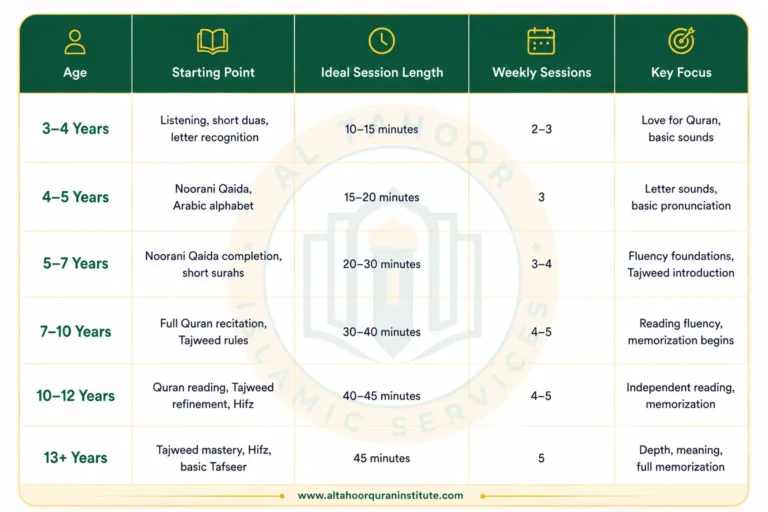
How to Memorize the Quran for Kids: Age-Specific Guidance
Children between ages 5 and 12 are in their cognitive golden window. Their phonological memory is at peak capacity, they learn sounds without accent interference, and they form habits quickly. The approach must match their developmental stage.
Ages 4 to 7: Build the Foundation
- Start with short surahs from Juz Amma: Al-Fatiha, Al-Ikhlas, Al-Falaq, An-Nas, Al-Kawthar.
- Use listening as the primary method. Play Quranic recitations during car rides, mealtimes, and bedtime.
- Keep sessions under 15 minutes. Attention spans at this age cannot sustain longer Hifz practice.
- Use positive reinforcement: praise progress, celebrate milestones with small rewards.
- Never pressure or compare. Early negative associations with the Quran can last a lifetime.
Ages 8 to 12: Build the Habit
- Increase daily session to 20 to 30 minutes with a fixed post-Fajr routine.
- Introduce a simple revision system: review yesterday’s portion before new memorization.
- Use visual aids like colour-coded Mushafs and progress charts displayed on the wall.
- Enrol in structured Hifz classes with a dedicated teacher for weekly accountability.
- Encourage children to recite memorized surahs in their own daily prayers.
Ages 13 and Above: Build the System
- Introduce the full Sabaq-Sabqi-Manzil system with clear daily targets.
- Self-test regularly by reciting without looking, then checking for errors immediately.
- Keep a mistake journal: write down words frequently confused or forgotten and drill them separately.
For young learners in the US, UK, Canada, and Australia, explore Al Tahoor’s online Quran classes for kids — structured, child-friendly sessions with certified teachers who specialize in children’s Hifz.
Is your child ready to start Hifz?
Al Tahoor Quran Institute offers personalized 1-on-1 online Hifz sessions with certified Hafiz teachers. Flexible timing. Free trial class. Students from 40+ countries.
How to Memorize the Quran as an Adult: It Is Never Too Late
Adult learners often assume children have an unfair advantage in Hifz. Children do memorize faster in early childhood, but adults bring powerful compensations: they understand meaning more deeply, apply techniques more deliberately, and are far more motivated by genuine choice rather than parental instruction.
The biggest challenge for adults is not ability — it is consistency. A working parent or professional who commits to 30 to 45 minutes per day, six days per week, can realistically complete Hifz in three to five years. Here is how to make that commitment sustainable.
Protect Your Memorization Time Like a Business Meeting
Put your Hifz session in your calendar as a non-negotiable appointment. After Fajr works best for most adults because it precedes the day’s distractions. If Fajr is not feasible, identify the 30 minutes in your day that is most reliably free and defend that time unconditionally.
Leverage Meaning to Boost Retention
Adults retain information far better when they understand it. Before memorizing a new passage, read a brief translation and a simple Tafsir summary. Even a two-minute review of the meaning will anchor the ayat in your semantic memory alongside your phonological memory. This dual encoding is one of the greatest advantages adult learners have.
Use Commuting Time for Revision
Play surahs you have already memorized during your daily commute. This passive listening reinforces existing memory without requiring any additional time investment. Over one year, a 30-minute daily commute adds more than 180 hours of revision — equivalent to months of formal study.
Adults looking for a structured online program can explore the online Quran classes for adults at Al Tahoor — flexible scheduling designed around real working and family commitments.
7 Common Hifz Mistakes That Ruin Memorization (And How to Fix Each One)
Mistake 1: Rushing Through New Pages
Fast recitation hides Tajweed slips and creates weak memory from the start. The fix: read each chunk slowly three times before any memorization attempt. Your tongue must be comfortable with the sound before your brain can store it reliably.
Mistake 2: Skipping Daily Revision (Manzil)
Research on the forgetting curve shows that without revision, learners lose up to 90 percent of new information within a month. The fix: always revise before adding new material. New memorization without consistent revision is like filling a leaking bucket.
Mistake 3: Memorizing Without Tajweed
Errors encoded early become permanent fixtures in memory and take weeks of deliberate correction to remove. The fix: learn basic Tajweed before starting Hifz and recite every new verse to a qualified teacher before considering it memorized.
Mistake 4: Switching Mushafs
Each time you switch to a different Quran edition, the visual memory layout you have built is disrupted completely. The fix: commit to one Mushaf from day one and use only that edition throughout your entire Hifz journey.
Mistake 5: Memorizing Without Accountability
Without someone to recite to regularly, mistakes go uncorrected and motivation deteriorates quietly. The fix: find a qualified teacher, a Hifz partner, or join an online Hifz program where regular recitation to a teacher is built into the structure.
Mistake 6: Inconsistent Daily Timing
Memorizing at different times each day prevents the brain from building the automatic habit trigger that makes sessions effortless. The fix: fix a single daily time and treat it as non-negotiable, even on difficult days.
Mistake 7: Confusing Mutashabihat (Similar Verses)
Dozens of ayat in the Quran share near-identical phrasing with subtle differences. These are called Mutashabihat. The fix: when you encounter a Mutashabihat, compare both versions side by side, write out the specific difference, and drill it until the distinction is locked in memory.
The Spiritual Side of Hifz: Dua, Sincerity, and Heart Connection
The Quran is not like any other text. Scholars across centuries have documented that it responds to sincerity in a way that worldly memorization does not. This is not metaphor — it is the lived experience of every Hafiz who completed the journey.
Dua Before Every Session
Begin each memorization session with Surah Al-Fatiha, Durood Ibrahim, and the dua: ‘Rabbi zidni ilma’ (O my Lord, increase me in knowledge). This act of turning to Allah before opening the Quran is itself a form of worship that Hifz teachers say transforms the quality and speed of memorization.
Purity of Heart and Consistent Prayer
Classical scholars including Imam Al-Shafi’i documented how sinful behaviour weakens memory for the Quran. Consistency in the five daily prayers, maintaining wudu before touching the Mushaf, and avoiding major sins are spiritual practices that have accompanied successful Hifz since the time of the Companions of the Prophet (ﷺ).
Understanding Tafsir for Deeper Retention
Reading a basic Tafsir alongside memorization creates multiple memory hooks: linguistic, narrative, emotional, and spiritual. When you know that Surah Al-Kahf’s story of the People of the Cave is about steadfastness under oppression, the words do not just sit in your memory — they live in your understanding. This is why scholars say the Quran is memorized with the heart, not just the tongue.
Combine your Hifz with Quran understanding through the Quran Tafseer online classes at Al Tahoor — a course that deepens both your comprehension and your spiritual connection to Allah’s words.
A Parent’s Guide: How to Support Your Child’s Hifz Journey
Parents are the single greatest variable in a child’s Hifz success. Your involvement, attitude, and consistency matter more than any curriculum or teaching method.
Create a Quran-Rich Environment
Play Quran recitations at home during everyday moments — breakfast, car journeys, before bed. When the Quran is the soundtrack of the home, children absorb its rhythms and vocabulary passively before any formal memorization begins. This dramatically reduces resistance when Hifz sessions start.
Be the Listener, Not Just the Supervisor
Ask your child to recite to you daily, even if you do not know Arabic. Your engaged attention is enough. It creates accountability, shows that the Quran is valued in your household, and gives your child an audience that motivates continued effort.
Celebrate Every Milestone
Completing a surah, finishing a juz, or maintaining a 30-day streak all deserve genuine acknowledgment. The emotional memory of parental celebration becomes permanently associated with Hifz progress. Children who feel genuinely proud of their milestones almost never abandon the journey.
Never Use Hifz as Punishment
One of the most damaging patterns is using Quran practice as a consequence for misbehaviour. This creates a negative association that can last decades. Keep Hifz positive, voluntary, and spiritually framed at all times.
For structured Islamic education alongside Hifz, explore Islamic studies for kids at Al Tahoor — a complementary program that builds faith knowledge alongside Quran memorization.
Where to Start Memorizing the Quran: Which Surah Should You Begin With?
This is one of the most common questions from new Hifz students. The answer depends on your current level and goals.
Beginners: Start with Juz Amma (30th Juz)
Juz Amma contains the shortest surahs in the Quran. Starting here gives you fast wins, builds confidence, and embeds the surahs most used in daily prayer. Most children complete Juz Amma before age 10 with just 15 to 20 minutes of daily practice.
Recommended starting order: Al-Fatiha, Al-Ikhlas, Al-Falaq, An-Nas, Al-Kawthar, Al-Asr, Al-Fil, Al-Humazah, then continue backwards through Juz Amma toward An-Naba.
Intermediate Learners: Juz 29 and Juz 28
After completing Juz Amma, move to Juz 29 and then Juz 28. These contain surahs of medium length that deepen the memorization habit without overwhelming students still building their daily routine.
Advanced Students: Surah Al-Baqarah and Long Surahs
Surah Al-Baqarah is the longest surah in the Quran. Some scholars recommend that students with strong memory and discipline start here because completing it early builds extraordinary mental endurance for the rest of the journey. This approach is not recommended for young children or casual learners.
How to Maintain Quran Memorization and Never Forget It
Many people complete Hifz only to lose large portions within two or three years. This is a serious concern in the Muslim community, but it is entirely preventable with the right revision system.
The Rotating Manzil System for Lifetime Retention
Divide the entire Quran into seven equal portions (roughly four to five juz each). Recite one portion per day of the week, completing a full rotation every week. A Hafiz who follows this system never lets more than seven days pass without reciting any part of their memorization.
Recite in Tarawih and Tahajjud
The most sustainably active Huffaz are those who regularly lead Tarawih prayers during Ramadan and recite long portions in Tahajjud throughout the year. Reciting to a congregation creates social accountability and emotional investment that passive revision alone cannot match.
Identify and Drill Your Weak Spots
Most Huffaz who lose memorization do not lose it evenly. Certain surahs, certain pages, and certain ayat consistently weaken first. Keep a written or digital log of weak spots and drill them disproportionately rather than spending equal time across all memorized material.
Never Stop Revision Completely
Even during travel, illness, exams, or a new job, 10 minutes of Manzil review per day is enough to maintain existing memorization. Abandoning revision entirely for even two weeks can cause months of deterioration that takes far longer to recover.
Start Your Hifz Journey with a Certified Teacher
Al Tahoor Quran Institute provides structured 1-on-1 online Hifz programs for children and adults. Expert Hafiz teachers. Flexible schedules. Free trial class available.
Frequently Asked Questions About Quran Memorization
Your Hifz Journey Starts With One Verse
The best way to memorize the Quran is not the fastest way or the most ambitious way. It is the way you can sustain every single day, built on correct pronunciation, structured revision, and genuine spiritual connection to Allah’s words
.
Start with what you know today. If you cannot read Arabic yet, begin with Noorani Qaida. If you can read but have not corrected your Tajweed, spend two to three months doing that before your first memorization session. If you are ready to memorize, begin with Al-Fatiha tonight and find a qualified teacher this week.
The Quran has been preserved in the hearts of millions of ordinary people across fourteen centuries. A shepherd memorized it in the desert. A merchant memorized it between trade journeys. A mother memorized it between caring for her children. The journey is available to you exactly as you are, starting right now.
If you want expert, structured guidance from day one, the online Quran memorization program at Al Tahoor Quran Institute provides certified Hafiz teachers, flexible 1-on-1 scheduling, and a proven curriculum for students across the US, UK, Canada, Australia, and Pakistan. Your free trial class is waiting.
Ready to Begin Your Hifz Journey?
Book your free trial class today. No commitment. Just you, a certified Hafiz teacher, and the Quran.
Book Free Trial Class at Al Tahoor 100% Free Trial • No Credit Card Required