Dua Qunoot: Arabic Text, Meaning, and the Right Way to Recite It in Witr Prayer
Every night, across mosques and homes worldwide, Muslims raise their hands in the final rak’ah of Witr prayer and recite a short, powerful supplication called Dua Qunoot. In one breath, it asks Allah for guidance, protection, mercy, and forgiveness. Yet many people recite it without knowing its meaning, its ruling, or even its correct Arabic wording.
This guide gives you the authentic Arabic text of Dua Qunoot, its transliteration, and a clear English translation. You will learn exactly when to recite it, whether it is Wajib or Sunnah in your madhhab, and how to memorize it in simple steps. We also cover Qunoot Nazilah, the version recited during hardship, and answer the questions people ask most often about this dua.
What Is Dua Qunoot?
Dua Qunoot is a short Islamic supplication recited while standing in prayer, most often in the third rak’ah of Witr. It is one of the few duas Prophet Muhammad ﷺ personally taught, word for word, to a member of his own family, which is part of why it carries such weight among scholars.
The Meaning of the Word “Qunoot”
The word Qunoot comes from an Arabic root meaning humility, obedience, and standing in devotion. In fiqh, scholars use it specifically for a dua recited while standing inside salah, distinct from the free-form dua you might make outside of prayer.
Where Dua Qunoot Comes From
The most recited version of Dua Qunoot traces back to Al-Hasan ibn Ali, the grandson of Prophet Muhammad ﷺ. He said the Prophet ﷺ taught him these exact words to recite in Witr. This narration appears in Sunan Abu Dawood, Jami at-Tirmidhi, and Sunan an-Nasa’i, three of the most trusted hadith collections in Islam. Because the Prophet ﷺ taught it directly, scholars across all four madhhabs agree it carries genuine Sunnah standing, even where they differ on how necessary it is.
Dua Qunoot in Arabic (Authentic Text)
This is the Arabic text narrated from Al-Hasan ibn Ali. It is the version most commonly recited in the Shafi’i, Hanbali, and Maliki traditions, and is also widely memorized across the Hanafi world.
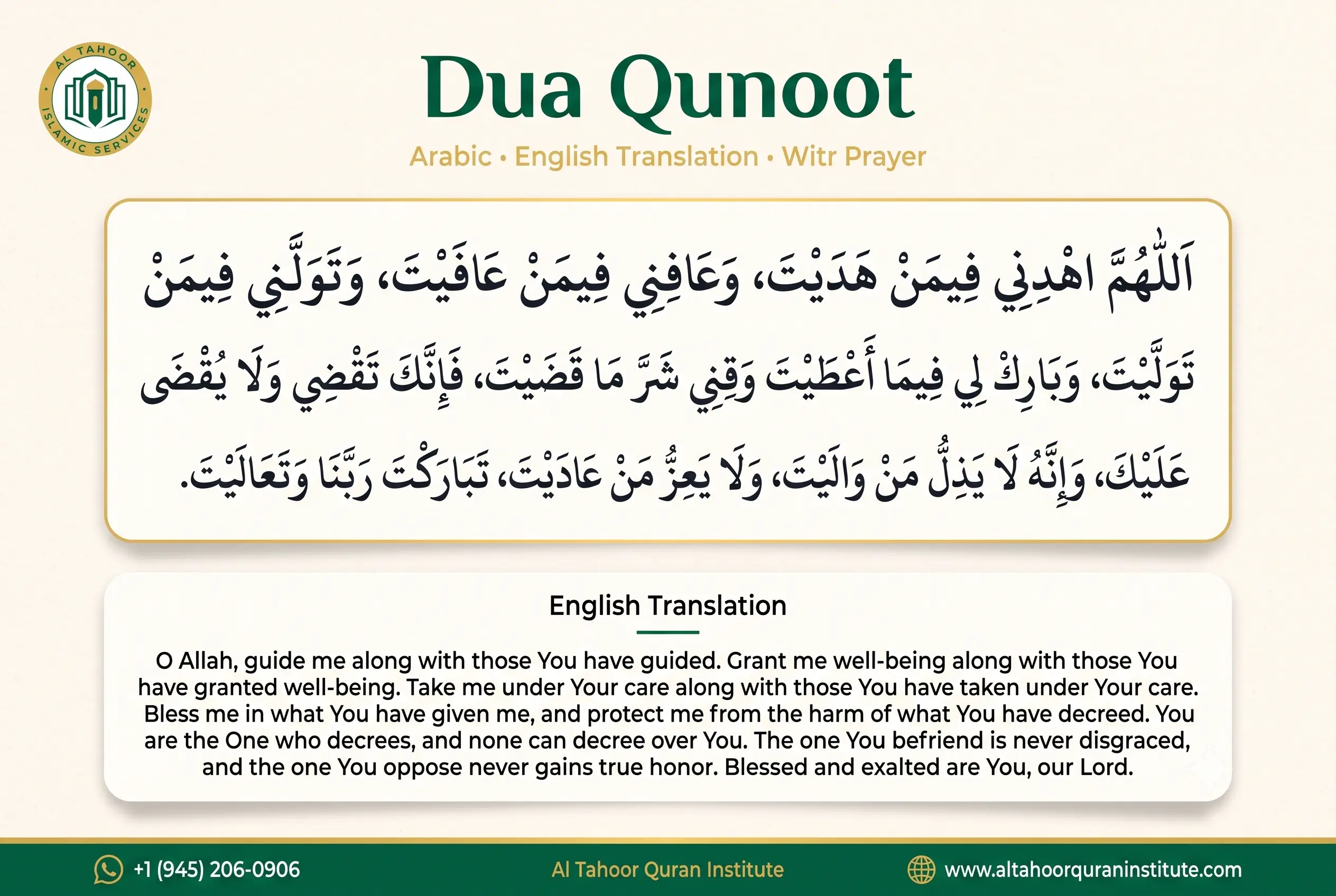
اللَّهُمَّ اهْدِنِي فِيمَنْ هَدَيْتَ، وَعَافِنِي فِيمَنْ عَافَيْتَ، وَتَوَلَّنِي فِيمَنْ تَوَلَّيْتَ، وَبَارِكْ لِي فِيمَا أَعْطَيْتَ، وَقِنِي شَرَّ مَا قَضَيْتَ، فَإِنَّكَ تَقْضِي وَلَا يُقْضَى عَلَيْكَ، وَإِنَّهُ لَا يَذِلُّ مَنْ وَالَيْتَ، وَلَا يَعِزُّ مَنْ عَادَيْتَ، تَبَارَكْتَ رَبَّنَا وَتَعَالَيْتَ
Dua Qunoot Transliteration (Easy to Read)
If you cannot yet read Arabic script, this transliteration lets you recite Dua Qunoot correctly while you learn the original letters alongside it.
Allahumma-hdini fiman hadayt, wa ‘afini fiman ‘afayt, wa tawallani fiman tawallayt, wa barik li fima a’tayt, wa qini sharra ma qadayt, fa innaka taqdi wa la yuqda ‘alayk, wa innahu la yadhillu man walayt, wa la ya’izzu man ‘adayt, tabarakta Rabbana wa ta’alayt.
Dua Qunoot Translation in English (Full Meaning)
Understanding the words you say in prayer changes how you experience it. Here is the meaning of Dua Qunoot in plain English:
“O Allah, guide me along with those You have guided. Grant me well-being along with those You have granted well-being. Take me under Your care along with those You have taken under Your care. Bless me in what You have given me, and protect me from the harm of what You have decreed. You are the One who decrees, and none can decree over You. The one You befriend is never disgraced, and the one You oppose never gains true honor. Blessed and exalted are You, our Lord.”
The Hanafi Version of Dua e Qunoot (Second Dua)
Alongside the Hasan ibn Ali version, many Hanafi worshippers recite a second, longer dua, traced through the companion Umar ibn al-Khattab رضي الله عنه. Some scholars permit combining both duas in the same rak’ah, so it’s worth knowing both by heart.
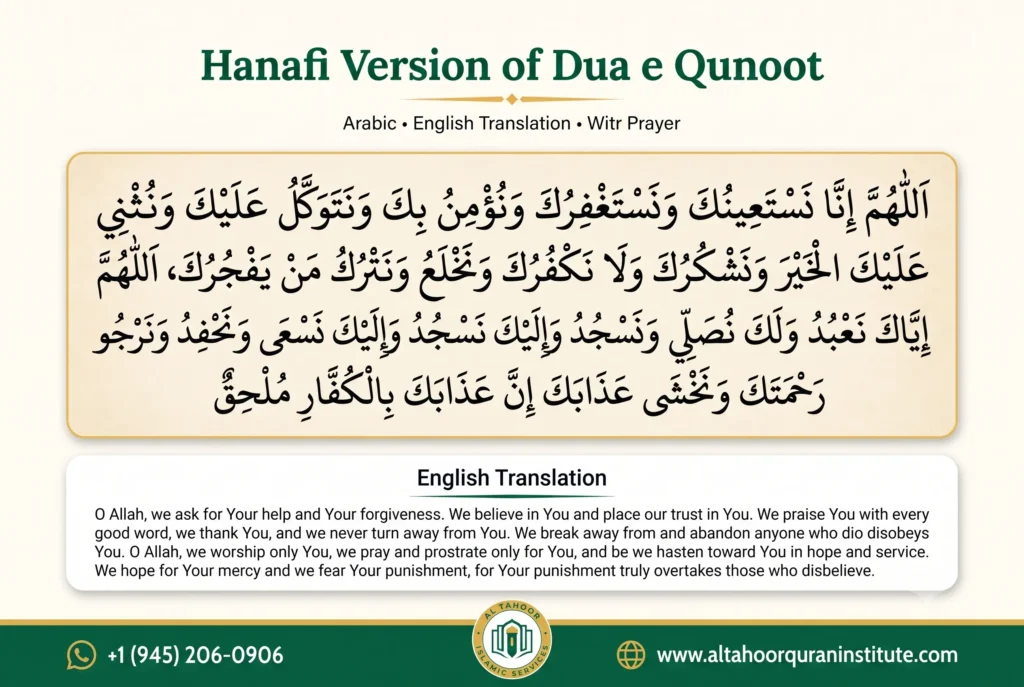
اللَّهُمَّ إِنَّا نَسْتَعِينُكَ وَنَسْتَغْفِرُكَ وَنُؤْمِنُ بِكَ وَنَتَوَكَّلُ عَلَيْكَ وَنُثْنِي عَلَيْكَ الْخَيْرَ وَنَشْكُرُكَ وَلَا نَكْفُرُكَ وَنَخْلَعُ وَنَتْرُكُ مَنْ يَفْجُرُكَ، اللَّهُمَّ إِيَّاكَ نَعْبُدُ وَلَكَ نُصَلِّي وَنَسْجُدُ وَإِلَيْكَ نَسْعَى وَنَحْفِدُ وَنَرْجُو رَحْمَتَكَ وَنَخْشَى عَذَابَكَ إِنَّ عَذَابَكَ بِالْكُفَّارِ مُلْحِقٌ
Allahumma inna nasta’inuka wa nastaghfiruka, wa nu’minu bika wa natawakkalu ‘alayka, wa nuthni ‘alaykal-khayra wa nashkuruka wa la nakfuruka, wa nakhla’u wa natruku man yafjuruk. Allahumma iyyaka na’budu wa laka nusalli wa nasjudu, wa ilayka nas’a wa nahfidu, wa narju rahmataka wa nakhsha ‘adhabaka, inna ‘adhabaka bil-kuffari mulhiq.
“O Allah, we ask for Your help and Your forgiveness. We believe in You and place our trust in You. We praise You with every good word, we thank You, and we never turn away from You. We break away from and abandon anyone who disobeys You. O Allah, we worship only You, we pray and prostrate only for You, and we hasten toward You in hope and service. We hope for Your mercy and we fear Your punishment, for Your punishment truly overtakes those who disbelieve.”
When Should You Recite Dua Qunoot?
Dua Qunoot has one primary home in the prayer, plus two situational uses that every Muslim should recognize.
During Witr Prayer (Daily and in Ramadan)
The most common time is the final rak’ah of Witr, prayed after Isha. In Ramadan, imams often extend it noticeably during Taraweeh, especially through the last ten nights, when congregations stand longer in hope of Laylatul Qadr.
Qunoot Nazilah: During Hardship and Calamity
Qunoot al-Nazilah is a special form recited during widespread hardship, such as war, disease, or oppression against Muslims. Its origin traces to the Bir Ma’unah tragedy, when seventy reciters of the Quran were killed and the Prophet ﷺ recited Qunoot in Fajr prayer for a month afterward, asking Allah for relief. This version can be added to Fajr or any obligatory prayer, typically after rising from ruku in the final rak’ah, and its exact wording is not fixed.
Other Times Scholars Permit Qunoot
- During personal hardship or major loss
- When making dua for the wider Muslim community (the Ummah)
- During Tahajjud or Qiyam al-Layl, the voluntary night prayer
Is Dua Qunoot Wajib or Sunnah? Ruling by Madhhab
Whether Dua Qunoot is obligatory depends entirely on which madhhab you follow. Here is each school’s position, based on classical fiqh manuals and mainstream contemporary fatwa guidance.
Hanafi Ruling
In the Hanafi school, reciting a Qunoot dua in Witr is wajib, meaning necessary. Omitting it without a valid excuse calls for sujood as-sahw, the prostration of forgetfulness, before ending the prayer.
Shafi’i Ruling
Shafi’i scholars treat Qunoot as a confirmed Sunnah (Sunnah Mu’akkadah) in Witr, especially during the second half of Ramadan. Leaving it out does not invalidate the prayer, though reciting it earns extra reward.
Hanbali Ruling
The Hanbali school considers Qunoot a Sunnah mainly during Ramadan Witr. Outside Ramadan it is not commonly practiced unless the situation calls for Qunoot al-Nazilah.
Maliki Ruling
Maliki fiqh does not include Qunoot as part of Witr at all. Instead, Malikis reserve Qunoot for the Fajr prayer, and only during times of calamity, following the Nazilah tradition.
| Madhhab | Status in Witr | Timing |
|---|---|---|
| Hanafi | Wajib (necessary) | Before ruku, third rak’ah |
| Shafi’i | Sunnah Mu’akkadah | After ruku, final rak’ah |
| Hanbali | Sunnah (mainly Ramadan) | After ruku |
| Maliki | Not part of Witr | Practiced in Fajr, Nazilah only |
Do You Recite Dua Qunoot Before or After Ruku?
This is one of the most searched practical questions about Dua Qunoot, and the answer genuinely depends on your madhhab. Hanafis recite it before ruku, immediately after finishing their Quran recitation in the third rak’ah of Witr, then say takbir and bow. Shafi’i and Hanbali worshippers recite it after ruku, standing upright again before going into sujood. This difference comes from authentic hadith describing the Prophet performing Qunoot both ways at different times, which is why classical scholars accepted both positions rather than declaring one incorrect.
Dua Qunoot vs Qunoot Nazilah vs Taraweeh Dua: What’s the Difference?
These three terms get mixed up constantly. This table separates them clearly, based on when each is recited, who recites it, and how fixed the wording is.
| Type | When Recited | Who Recites It | Wording |
|---|---|---|---|
| Regular Witr Qunoot | Every Witr prayer, third/final rak’ah | Every praying Muslim, individually or led by an imam | Fixed Hasan ibn Ali or Hanafi version |
| Qunoot al-Nazilah | Only during widespread hardship or calamity | Imam leads, congregation says Ameen | Flexible Situational pleas for relief |
| Fajr Qunoot (Shafi’i) | Daily, in Fajr prayer | Shafi’i worshippers as regular practice | Fixed Similar core wording |
| Taraweeh / Last-10-Nights Dua | Ramadan congregational night prayer | Imam, often lengthened for effect | Often Extended Not strictly fixed |
| Personal Qunoot in Tahajjud | Optional night prayer, any night | Individual, praying alone | Flexible Personal additions allowed |
How to Recite Dua Qunoot Step by Step
Here is the general Hanafi sequence for Witr, since it involves one extra step most people don’t expect:
- Pray the first two rak’ahs of Witr as normal, then sit for tashahhud and stand for the third.
- Recite Surah Al-Fatiha and a second surah, exactly as in any other rak’ah.
- Say the takbir (“Allahu Akbar”) and raise your hands to your ears.
- Recite Dua Qunoot quietly, whether praying alone or following an imam.
- Say takbir again and go into ruku, then complete the rest of the prayer as usual.
If you follow the Shafi’i or Hanbali method, simply move steps 3 and 4 to after you rise from ruku, standing upright, before going into sujood.
How to Memorize Dua Qunoot Easily
Dua Qunoot is only nine short phrases. Most learners, including children, can memorize it properly within a week using this approach:
- Listen to a clear, slow recitation daily so your ear learns the sound before your tongue attempts it.
- Split the dua into its nine natural phrases and master one at a time, not the whole thing at once.
- Read the transliteration alongside the Arabic until the pronunciation feels natural.
- Learn the English meaning phrase by phrase, so you’re memorizing understanding, not just sound.
- Recite it aloud once daily after Isha, even outside of prayer, to build muscle memory.
- Write it out by hand once or twice. Handwriting anchors memorization far better than reading alone.
- Test yourself without looking, then check against the text, and repeat until you don’t need it.
Why Dua Qunoot Strengthens Your Connection With Allah
Beyond its ruling, Dua Qunoot packs several spiritual themes into a few short lines:
- It opens with a request for guidance (hidayah), the single most important thing a believer can ask for.
- It asks for afiyah, complete well-being in body, faith, and family, as a form of protection before hardship strikes.
- It affirms qadar, Allah’s decree, which builds patience and lowers ego-driven expectations of life.
- It closes with praise and exaltation, modeling the correct etiquette of ending any dua on gratitude.
Teaching Kids and New Muslims to Recite Dua Qunoot
Children and new Muslims often find Dua Qunoot intimidating simply because of its length compared to shorter duas. Break it into the nine phrases above, use a printed card with Arabic, transliteration, and meaning side by side, and review one new line each week during Witr. Consistency beats speed every time.
If you’d rather have a certified teacher guide your child or a new Muslim in your family through Dua Qunoot and other daily duas correctly, Al Tahoor Quran Institute’s Islamic Studies program covers pillars of prayer, daily duas, and correct pronunciation with certified male and female tutors, in a live one-on-one setting.
Frequently Asked Questions About Dua Qunoot
Dua Qunoot is a short supplication Muslims recite while standing in prayer, most commonly in the third rak’ah of Witr, asking Allah for guidance, well-being, and protection.
No. Dua Qunoot is not found in the Quran. It comes from authentic hadith, specifically the narration in which Prophet Muhammad taught it directly to his grandson, Al-Hasan ibn Ali.
It depends on your madhhab. Hanafis consider it wajib in Witr. Shafi’is and Hanbalis treat it as Sunnah. Malikis don’t include it in Witr at all, reserving Qunoot for Fajr during hardship.
Hanafis recite Dua Qunoot before ruku, right after finishing their Quran recitation in the third rak’ah of Witr. Shafi’i and Hanbali worshippers recite it after rising from ruku.
Your prayer is still valid. Hanafi fiqh asks you to perform sujood as-sahw, the prostration of forgetfulness, before finishing. Shafi’i and Hanbali fiqh do not require this correction.
Inside the actual prayer, the dua should be recited in Arabic. If you haven’t memorized it yet, scholars allow reciting any other short, respectful dua in Arabic until you learn it. Reading the English meaning outside of prayer is encouraged to build understanding.
Yes. Dua Qunoot is part of Witr for both men and women. There is no restriction on women reciting it individually at home.
Most scholars permit reading it from paper or a screen if you haven’t memorized it yet, particularly for beginners and children. Memorizing it over time remains the recommended long-term goal.
Qunoot al-Nazilah is recited only during widespread hardship, such as war or disaster, usually in Fajr prayer. Unlike the fixed wording of Witr Qunoot, its phrasing is flexible and addresses the specific calamity.
When praying Witr alone, recite it quietly. When an imam leads the prayer, especially in Ramadan or during Qunoot al-Nazilah, he may recite it aloud while the congregation says Ameen.
Either is authentically sourced. Shafi’i, Hanbali, and Maliki worshippers typically recite the Hasan ibn Ali version. Hanafis commonly recite the second, longer version, and some scholars permit combining both.
Break it into its nine natural phrases, use a card with Arabic, transliteration, and meaning together, and review one phrase a week during Witr rather than rushing the whole dua at once.
Final Thoughts: Make Dua Qunoot Part of Your Nightly Worship
Dua Qunoot takes less than thirty seconds to recite, yet it covers guidance, protection, mercy, and gratitude in a single breath. Start with the version your madhhab follows, learn the Arabic phrase by phrase, and let the English meaning sink in as you go. Within a week of consistent practice after Isha, most people have it memorized for life.
If you want a structured next step, start with the Hasan ibn Ali version tonight, add the transliteration tomorrow, and review the meaning by the weekend. If you’d like a certified teacher to check your pronunciation and Tajweed as you learn it, Al Tahoor Quran Institute offers a free trial class with qualified male and female tutors.
Ready to learn Quran with a qualified teacher?
One-on-one live class · Level check included · No credit card needed