Can Kids Learn Quran Online Effectively? A Complete Parent Guide
Every parent who has searched for a Quran teacher knows the frustration. Local options are limited. Madrassa schedules clash with school. And finding a qualified teacher who is also good with kids feels nearly impossible. That is exactly why millions of Muslim families worldwide now choose online Quran classes for kids as their primary path to Quranic education.
But a fair question sits at the back of every parent’s mind: is online learning truly effective for a child? Or is it just a convenient compromise? This guide answers that question honestly, age by age, method by method, with the clarity parents need to make a confident decision.
Is Online Quran Learning as Effective as In-Person Classes for Children?
Online Quran learning is equally effective as in-person teaching when the class structure matches the child’s age, the teacher is certified in Tajweed and child-friendly pedagogy, and parents stay involved at home. For families in non-Muslim countries where local Islamic education is scarce, online learning is often superior because it connects children with native Arabic-speaking scholars they would never access locally.
Children are digital natives. They watch videos, play games, and communicate on screens before they can read. The learning medium itself is never the barrier. The barrier is poor structure, unqualified teachers, or sessions that are too long for a child’s attention span. Get those three things right and your child can make remarkable progress.
A 2025 Yaqeen Institute survey of 1,200 Muslim households found that children who associate Quran learning with warmth and positive experiences are significantly more likely to maintain daily recitation into adulthood. Whether that positive experience happens online or in person matters far less than whether it happens at all.
What Age Can Kids Start Learning Quran Online?
Children can begin online Quran learning as early as age 3 to 4 through listening, repetition, and short surah recognition. Structured reading through Noorani Qaida online typically begins around age 4 to 5. The best window for building fluency and beginning memorization is ages 5 to 10, when the brain’s capacity for language acquisition and pattern recognition is at its peak. However, there is no age limit on the upper end.
Islamic educators have long observed what neuroscience now confirms: learning Arabic phonemes between ages 3 and 7 thickens the auditory cortex, making pronunciation more natural and durable. Starting early does not just speed up Quran learning. It makes correct pronunciation genuinely easier because a young child’s vocal cords are flexible and can mimic the unique sounds of Arabic letters far more easily than older learners.
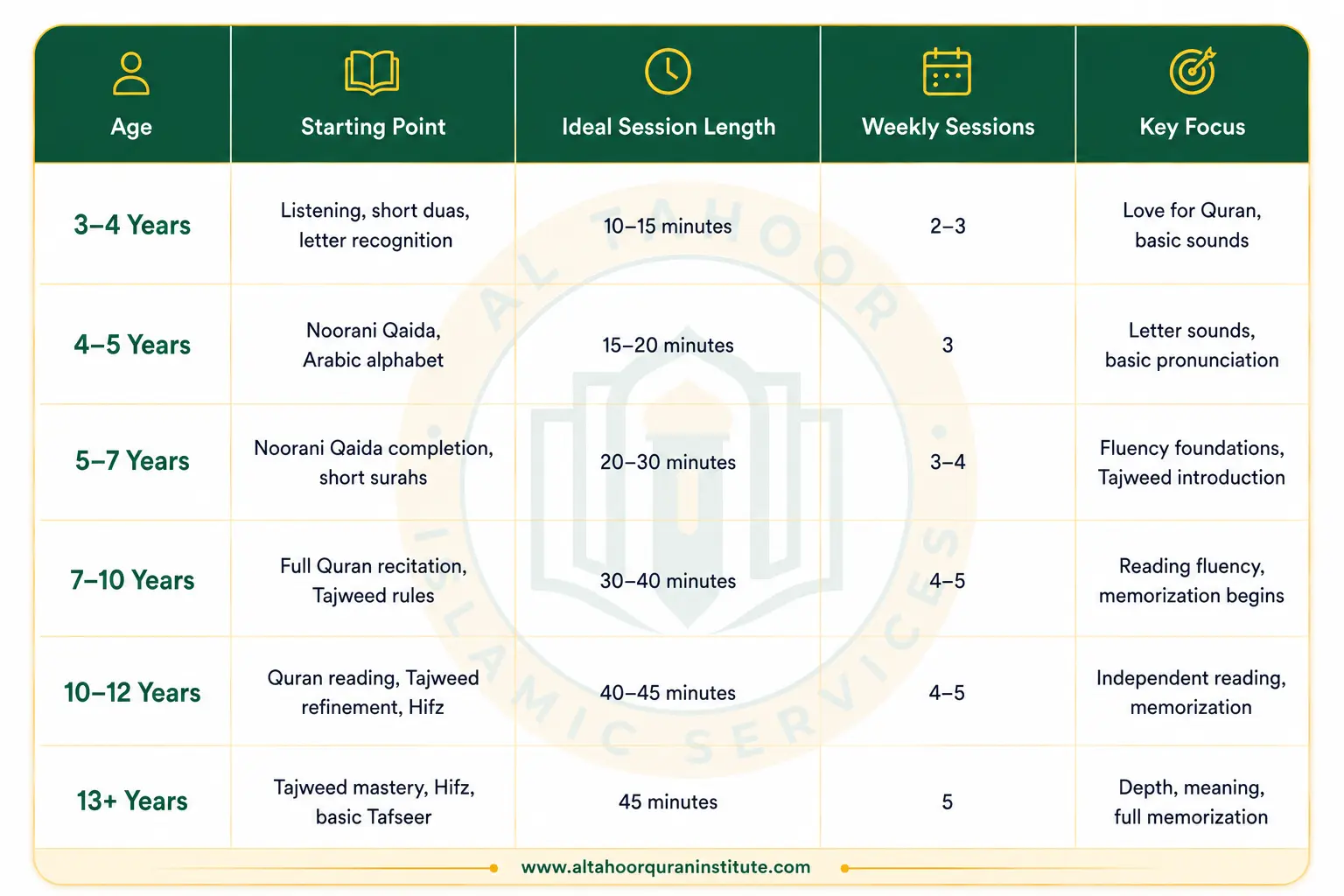
Age-by-Age Quran Learning Roadmap
How Online Quran Classes for Kids Actually Work
A child’s online Quran class runs as a live, one-on-one video session with a certified teacher through platforms like Zoom or a dedicated learning portal. The teacher and student interact in real time. Pronunciation is corrected immediately. Progress is tracked session by session, and parents receive regular reports.
Here is exactly what a well-structured session looks like, step by step:
- The child joins the session at their scheduled time from a quiet space at home.
- The teacher opens with a warm-up, reviewing the last lesson’s content through brief recitation.
- New material is introduced using digital Noorani Qaida, an interactive whiteboard, or visual letter cards.
- The child recites while the teacher listens carefully, correcting makharij (letter articulation points) and Tajweed rules in real time.
- The final 5 minutes revisit milestones, set a small home practice target, and close with positive reinforcement.
- A progress note is shared with parents after the session.
Reputable academies pair children with teachers trained not just in Tajweed but in child psychology. This distinction matters enormously. A scholar who cannot hold the attention of a 6-year-old for 25 minutes is not the right fit, regardless of their Ijazah credentials. Look for Tajweed classes online that combine scholarly knowledge with genuine child-friendly teaching methodology.
The Curriculum Journey: What Do Kids Learn and in What Order?
Every child who learns Quran online follows a logical curriculum progression. The sequence matters. Skipping steps creates gaps that are hard to correct later.
Stage 1: Noorani Qaida
Noorani Qaida is the universal starting point for non-Arabic speaking children. Developed by Sheikh Noor Muhammad Haqqani, it is a scientifically structured primer that moves from individual Arabic letters to compound letter forms, vowels, and the foundational rules of Tajweed. Most children in structured online classes complete Noorani Qaida in 4 to 8 months, depending on their age and frequency of sessions.
Stage 2: Quran Recitation with Basic Tajweed
Once the child can read independently from the Qaida, they move to the Quran itself. The teacher introduces Tajweed rules gradually: Madd (elongation), Ghunnah (nasalization), Waqf (pausing rules), Qalqala (echoing sounds), and the rules of Noon Sakinah and Tanween. These rules are taught through repetition and listening, not through dense theory.
Stage 3: Fluency and Surah Memorization
With recitation established, children work toward fluent reading through the Quran and begin memorizing surahs from Juz Amma, the 30th and most accessible part of the Quran. Memorization targets are set based on the child’s pace, typically 2 to 3 lines per day for younger children with a dedicated daily review session.
Stage 4: Hifz (Full Quran Memorization)
Children who show strong memory skills and consistent progress may enter a structured Hifz program. On average, children who begin Hifz between ages 7 and 10 with daily sessions complete the full Quran in 3 to 6 years. Online one-on-one Hifz programs use personalized revision schedules to ensure strong retention alongside new memorization.
Not sure where your child should start? Book a free trial class at Al Tahoor Quran Institute. Our teacher will assess your child’s level and recommend the right starting point. No obligation. No admission fee.
What Makes an Online Quran Teacher Truly Effective for Children?
Not every certified Quran scholar can teach children well. The difference between a child who loves their Quran class and one who dreads it usually comes down to the teacher, not the format. When evaluating a teacher or academy, these are the qualities that predict results:
- Ijazah or Tajweed certification: The teacher should have a verifiable chain of Quran transmission, ensuring they teach authentic pronunciation.
- Child psychology awareness: Understanding how children think, what motivates them, and how long different age groups can concentrate is a distinct skill.
- English language fluency: For children in the USA, UK, Canada, and Australia, a teacher who can explain concepts clearly in English bridges the Arabic-language gap.
- Patient correction style: The teacher corrects mistakes without discouraging the child. Tone and patience matter enormously for young learners.
- Progress reporting to parents: Regular, clear updates keep parents informed and allow them to support revision at home.
- Interactive tools: Teachers who use digital whiteboards, recitation recordings, visual aids, and reward systems keep children engaged far longer than those who rely on verbal instruction alone.
How Parents Can Support Quran Learning at Home
Parents are not a substitute for a qualified teacher, but they are the single most important factor in a child’s long-term Quran progress. Children whose parents actively participate and create a Quran-friendly home environment progress faster, retain more, and develop a genuine love for the Book of Allah.
Here is what active parental involvement looks like in practice:
- Set a fixed class time and protect it. Consistency trains the child’s mind to expect and prepare for learning.
- Sit nearby during early classes. For children under 7, parental presence significantly boosts confidence and focus.
- Do 5 to 10 minutes of daily revision. Ask your child to recite yesterday’s lesson before dinner or at bedtime.
- Create a distraction-free environment. Close unnecessary tabs, silence notifications, and keep the learning space calm.
- Play Quran recitation softly in the background at home. Passive listening builds familiarity with Quranic intonation and pronunciation.
- Celebrate milestones visibly. When your child completes a new surah, mark it. A certificate, a small reward, or a verbal acknowledgement goes a long way.
- Communicate regularly with the teacher. Ask for weekly feedback and share any changes in your child’s mood, school workload, or focus levels.
For children working toward Hifz, structured home revision is especially critical. An online Quran memorization course paired with consistent home review produces results that far outpace classroom-only learning.
Common Challenges Parents Face and How to Solve Them
Even in the best online programs, parents encounter predictable obstacles. Knowing how to handle them before they arise makes the difference between a child who sticks with their Quran education and one who drifts away from it.
Short Attention Span
This is the most common concern for children under 7. The solution is not longer sessions but better-structured ones. Sessions of 15 to 25 minutes with a brief stretch break in the middle work far better than 45-minute marathons. A good teacher changes activity every 10 to 15 minutes, moving between recitation, listening, visual exercises, and verbal review.
Screen Fatigue
Children who spend hours on screens for school may resist another screen for Quran class. Keep the screen strictly for the live session. Use printed Qaida pages or a physical Quran for home revision practice. This separation signals to the child that Quran time is different from screen entertainment.
Motivation Dips
Every child hits a phase where enthusiasm fades. This is normal and usually temporary. Reward milestones with visible celebration, not just verbal praise. Let the child choose a small reward when they complete a new section of Noorani Qaida or memorize a new surah. Connecting Quran learning to identity, faith, and family tradition gives children intrinsic motivation that outlasts any external reward.
Technical Problems
Internet connection issues interrupt learning. Have a backup plan ready: a mobile hotspot, a secondary device, or a recorded session policy with your academy. Progress lost to a dropped connection is frustrating for both child and teacher. Most good academies have a makeup class policy for technical failures.
Pronunciation Plateaus
Some children reach a point where their recitation sounds correct to an untrained ear but still contains subtle errors. Recorded playback is a powerful tool here. The teacher records a short section of the child reciting, plays it back, and lets the child identify the difference between their recitation and a model recitation. Self-hearing is remarkably effective for breaking pronunciation plateaus.
Should Children Also Learn Arabic Alongside Quran?
Learning basic Arabic language skills alongside Quran recitation deepens a child’s connection to what they are reading and reciting. Children who understand even 200 to 300 common Quranic words begin to experience the Quran as meaningful communication rather than a memorized sound sequence. Research shows that older children, particularly those aged 9 and above, disengage from Quran classes when they cannot understand what they are reciting.
Simple Quranic Arabic vocabulary, word meanings for common surahs, and basic Tafseer appropriate to the child’s age all support stronger retention and more authentic motivation. Many academies now offer Arabic language learning as a companion course alongside core Quran recitation, and this combination consistently produces the best long-term outcomes.
Islamic Studies for Kids Alongside Quran: Why It Matters
Quran recitation is the foundation, but Islamic studies for kids builds the structure around it. Children who learn the pillars of Islam, the stories of the Prophets, basic Aqeedah, daily duas, and Islamic manners alongside their Quran education develop a more integrated understanding of their faith. They see the Quran not as a standalone text but as the living guide it is meant to be.
Look for academies that offer or recommend a structured Islamic studies companion course. Even one short session per week on Islamic history, manners, or duas creates a richer learning environment and helps children answer questions from non-Muslim classmates with confidence and clarity.
10 Proven Methods That Make Online Quran Learning More Effective for Kids
These are the techniques that consistently produce the best results across age groups, learning styles, and cultural backgrounds.
- Start with listening before reading. Play Quran recitation softly at home weeks before formal classes begin. Familiarity reduces anxiety.
- Use the 5-minute daily revision rule. Even on non-class days, 5 minutes of revision before sleep protects retention.
- Choose a one-on-one format for the first 12 months. Personalized feedback during the foundational phase is invaluable.
- Ask for recorded sessions. Listening to their own recitation helps children identify mistakes independently.
- Connect Quran to daily prayer (Salah). When the child recognizes surahs they recite in prayer, motivation rises naturally.
- Use milestone charts. A visual chart of completed surahs or Qaida pages gives children a tangible sense of progress.
- Celebrate completions publicly within the family. A small ceremony when a child completes Noorani Qaida or memorizes Juz Amma creates lasting positive associations.
- Allow the child some agency. Let them choose a small aspect of their learning, such as which surah to memorize next, within the teacher’s guided framework.
- Match the teacher to the child’s personality. A shy child often thrives with a gentle, quiet teacher. An energetic child may need a more dynamic, game-based approach.
- Do not skip Tajweed. Early Tajweed instruction prevents pronunciation habits that become very difficult to correct later.
At Al Tahoor Quran Institute, certified teachers use all 10 of these methods in every child’s learning plan. Book a free 3-day trial for your child and see the difference qualified, child-friendly instruction makes.
Book Free 3-Day TrialOnline vs. In-Person Quran Learning for Kids: An Honest Comparison
| Factor | Online Quran Classes | Local In-Person Classes |
|---|---|---|
| Access to qualified teachers | Global pool of certified scholars | Limited to local availability |
| Safety and supervision | Parent can monitor every session | Varies by institution |
| Scheduling flexibility | High: evenings, weekends, any timezone | Low: fixed madrassa timings |
| Travel requirement | None | Daily or weekly commute |
| One-on-one instruction | Standard in most online academies | Often group-based |
| Gender-specific teacher option | Easy to arrange online | May not be available locally |
| Cost | Comparable or lower with more options | Varies widely |
| Progress tracking | Digital reports and recordings available | Informal, varies by teacher |
| Learning tools | Whiteboards, apps, visual aids | Physical books, board |
| Community aspect | Lower (but manageable with group classes) | Higher natural community |
Frequently Asked Questions About Kids Learning Quran Online
Can a 4-year-old really learn Quran online?
Yes, though the approach must match the age. A 4-year-old learns through listening, repetition, and visual recognition, not structured reading. Sessions should stay under 15 minutes, include plenty of positive reinforcement, and focus on Arabic letters and very short surahs like Surah Al-Ikhlas. With a patient, child-friendly teacher and active parental presence, 4-year-olds make real progress.
How many days per week should my child have Quran classes?
Three to five sessions per week is ideal for steady progress. Consistency matters more than the number of sessions per week. Three focused sessions with daily 5-minute home revision outperform five sessions with no home reinforcement. For Hifz students, daily sessions with structured revision schedules are typically recommended.
What is the difference between Noorani Qaida and Quran recitation classes?
Noorani Qaida is a preparatory primer that teaches the Arabic alphabet, letter sounds, vowels, and foundational Tajweed rules. It is not the Quran itself but a structured tool to prepare children to read the Quran correctly. Quran recitation classes begin after the child can read independently from the Qaida. Skipping the Qaida stage and going directly to the Quran typically results in persistent pronunciation errors.
Are online Quran classes safe for children?
Yes, when you choose a reputable academy with verified teachers, parent-observable sessions, and a clear child protection policy. Always ensure you can join or observe sessions at any time. Reputable academies use secure platforms, conduct background checks on teachers, and have formal safeguarding policies. Avoid any platform that does not allow full parental access to sessions.
Can my child achieve proper Tajweed through online classes?
Yes. Proper Tajweed requires real-time audio interaction and immediate correction, both of which are fully achievable in a live online one-on-one session. In fact, the recorded nature of online sessions can be used as a learning tool: the teacher plays back a portion of the child’s recitation and compares it to a model, helping the child identify and self-correct mistakes.
How long does it take for a child to read the Quran fluently?
With structured classes 3 to 5 times per week and daily home revision, most children achieve basic reading fluency within 12 to 24 months of starting Noorani Qaida. Progress depends on the child’s starting age, frequency of sessions, quality of teaching, and level of home support. Children who begin younger, around age 4 to 5, often progress more naturally due to the brain’s peak language acquisition window.
What is the ideal session length for kids in online Quran classes?
For children aged 4 to 6: 15 to 20 minutes. For children aged 7 to 9: 25 to 30 minutes. For children aged 10 and above: 30 to 45 minutes. These lengths balance productive learning with manageable attention spans. Longer sessions do not produce proportionally better results for children and often lead to fatigue and disengagement.
What technology does my child need for online Quran classes?
A tablet, laptop, or computer with a camera, a reliable internet connection, headphones or a clear speaker, and a quiet space are all that is needed. Some academies also use printed Qaida books alongside the digital session for home revision, reducing total screen time and helping children build a physical connection to the text.
The Right Time to Start Is Now
Children who begin Quran education early carry its benefits for the rest of their lives. The cognitive advantage of learning Arabic phonemes in early childhood, the spiritual foundation that Quran memorization builds, and the discipline that regular study cultivates are gifts that compound over time.
Online Quran learning removes every barrier that once stood between your child and a qualified teacher. Geography is no longer relevant. Schedule conflicts have solutions. Finding a certified, child-friendly teacher is possible without compromise.
The only variable that remains in your hands is the decision to start. Every week of delay is a week of learning your child does not get back. And every week of consistent, quality learning is a week of foundation that will never be taken away.
Choose a qualified academy, book a trial class, sit with your child for the first few sessions, and watch what happens. The results will speak far louder than any guide.
Give your child the gift of the Quran. Al Tahoor Quran Institute offers certified male and female teachers, flexible scheduling, and a structured curriculum from Noorani Qaida to Hifz. Start with 3 days completely free.
Book Your Free Trial