
How to Find the Best Online Quran Classes for Kids: A Complete Parent’s Guide
The best online Quran classes for kids combine certified Tajweed-qualified teachers, an age-appropriate structured curriculum (starting from Noorani Qaida), flexible scheduling, one-on-one sessions, and interactive tools that keep children engaged. Look for academies that offer a free trial class, regular progress reports, and a safe online environment. Classes are suitable for children aged 4 and above.
Every Muslim parent wants their child to grow up connected to the Quran. That bond does not happen by accident. It starts with the right teacher, the right program, and the right environment. And today, that environment does not have to be a madrasa around the corner. It can be right inside your home.
Online Quran classes for kids have grown dramatically over the past few years. Families in the UK, USA, Canada, Australia, UAE, and across the globe are turning to live virtual lessons as their primary choice for Quranic education. The reasons are practical: no commuting, flexible timing, access to certified scholars, and a safe supervised space for children.
But not every program delivers on that promise. This guide walks you through exactly what to look for, the questions you must ask before enrolling, a comparison of key features, and a clear decision framework based on your child’s age and level.If you are ready to explore a trusted program built for children, visit Al Tahoor Quran Institute’s Online Quran Classes for Kids section directly.
Why Are Online Quran Classes Becoming the Top Choice for Muslim Families?
Online Quran learning is no longer a backup option. For millions of Muslim families worldwide, it has become the primary path to Quranic education. Here is why the shift is happening.
Geographical Access to Qualified Scholars
Finding a certified Tajweed teacher locally is difficult, especially in non-Muslim-majority countries. Online platforms connect your child with Al-Azhar-trained scholars and Ijazah-certified reciters from Egypt, Pakistan, and across the Islamic world. Your child in London, Toronto, or Sydney can learn from the same quality of instruction available in Cairo or Islamabad.
Safety and Parental Supervision
Children learn in a familiar, safe environment with parents able to observe at any time. There is no commute, no exposure to outside risks, and full transparency between the academy and the family. Parents can sit in on sessions, review recordings, and receive regular progress updates.
Flexible Scheduling That Fits Modern Life
Online academies offer morning, evening, and weekend slots. You can build Quran lessons around school hours, extracurricular activities, and family routines. This consistency is what turns occasional learning into a daily habit.
One-on-One Attention for Faster Progress
Most reputable online programs offer individual sessions where the teacher focuses entirely on your child’s pronunciation, pace, and understanding. This personalized attention is rarely possible in a traditional group madrasa setting.
What to Look for in Online Quran Classes for Kids: 8 Non-Negotiables
Not every academy advertising online Quran lessons for children is equal. Before you enroll your child, evaluate each program against these eight criteria.
1. Teacher Certification and Child-Specialist Training
The teacher is the single most important factor. Look for instructors who hold an Ijazah (a chain of authorization to teach the Quran) and have specific training in working with children. Child psychology awareness, patience, and the ability to make lessons engaging are as important as scholarly credentials. Ask the academy directly about teacher qualifications before booking a trial.
2. Structured Age-Appropriate Curriculum
A strong curriculum starts with Noorani Qaida or the Arabic alphabet for beginners, then progresses through Makharij (articulation points), Tajweed rules, Quran recitation, memorization, and eventually Tafseer. Every stage should have clear learning objectives and assessment checkpoints. Avoid programs that jump straight into Quran recitation without first building a phonetic foundation.
3. Free Trial Classes Before Commitment
Any trustworthy academy will offer a free trial class. This session lets your child meet the teacher, experience the teaching style, and decide whether the learning environment feels right. Always take the trial before committing to a monthly plan.
4. Interactive Teaching Tools
Children learn through engagement, not passive listening. The best online Quran programs use digital interactive whiteboards, gamified progress tracking, educational quizzes, audio-visual aids, and regular review games. These tools are simply unavailable in a traditional setting and make a measurable difference in how quickly and happily children learn.
5. Male or Female Teacher Options
Many parents, particularly for young girls, strongly prefer female Quran teachers. Reputable academies offer both male and female instructors so families can choose based on comfort and preference. Confirm teacher gender options before enrollment.
6. Flexible Scheduling and Time Zone Support
If you are based in North America, Europe, or Australia, ensure the academy can accommodate your time zone. Morning, evening, and weekend slots should be available. Rigid scheduling that only works for Middle Eastern time zones is a practical barrier that breaks learning consistency.
7. Transparent Progress Reporting
Parents should never feel left in the dark about their child’s development. Look for programs that provide written progress reports, session recordings, parent feedback calls, and milestone certifications. A good academy welcomes parental involvement.
8. Safe and Secure Online Environment
Classes should be conducted on vetted, private platforms. Teachers should undergo background checks. Parents should be able to observe or record sessions. This is non-negotiable when it comes to child safety online.
Book a Free Trial Class at Al Tahoor Quran Institute Today
Understanding the Curriculum: What Should a Child Learn and in What Order?
A well-designed Quran curriculum for children follows a logical sequence. Skipping stages is one of the most common mistakes parents make when choosing a program. Here is the correct learning pathway.
Stage 1: Arabic Alphabet and Noorani Qaida
Every Quran learning journey begins with the Arabic alphabet and Makharij (the correct articulation points for each letter). The Noorani Qaida is the most widely used foundational text for this purpose. Children learn to recognize letters, pronounce them correctly, and join letters into words. This stage typically takes three to six months for young beginners.
Stage 2: Quran Recitation with Basic Tajweed
Once the child can read Arabic fluently, they begin reciting the Quran with attention to basic Tajweed rules such as Madd (elongation), Ghunnah (nasalization), and Waqf (stopping rules). The goal at this stage is fluent, accurate recitation. This stage may last six months to a year depending on frequency of lessons.
Stage 3: Surah Memorization
Memorization (Hifz) typically begins with Juz Amma (the 30th chapter), starting with shorter Surahs like Al-Fatiha, Al-Ikhlas, Al-Falaq, and Al-Nas. A structured Hifz plan with daily revision sessions is essential for retention. Children who memorize without regular revision often lose what they have learned.
Stage 4: Full Hifz Program (for motivated learners)
Full memorization of the Quran (30 Juz) is a major undertaking that typically takes three to six years for dedicated students. This requires five to six sessions per week, daily personal revision, and strong parental support. Not every child needs to pursue full Hifz, but the option should be available from a reputable academy.
Stage 5: Tafseer and Islamic Studies
Understanding the meaning of what is being recited deepens the child’s spiritual connection. Age-appropriate Tafseer (Quranic interpretation), Islamic manners (Adab), Seerah (Prophet’s biography), and basic Fiqh can be introduced alongside recitation and memorization.
One-on-One vs. Group Online Quran Classes: Which Is Better for Your Child?
One-on-one classes are generally better for children because the teacher can adapt entirely to the child’s pace, correct pronunciation in real time, and build a personal bond that encourages consistent attendance.
| Factor | One-on-One Classes | Group Classes |
|---|---|---|
| Personalization | Fully tailored to child’s pace and level | Fixed pace for all students |
| Pronunciation Correction | Immediate, real-time feedback | Limited, teacher manages multiple students |
| Engagement | High — teacher focused entirely on child | Varies — shy kids may disengage |
| Social Learning | Limited | Children interact with peers |
| Cost | Higher monthly fee | Lower monthly fee |
| Best For | Most children, especially beginners | Confident learners wanting social element |
| Progress Speed | Faster | Slower on average |
For most children, especially those just starting out or those who are shy or have shorter attention spans, one-on-one online Quran classes produce the best results. The teacher can slow down on difficult letters, repeat sections as needed, and build the kind of trusting relationship that makes a child look forward to lessons.
Key Features to Compare When Choosing an Online Quran Academy for Kids
Use this checklist when evaluating any online Quran academy. Request this information directly from the institute before booking a trial.
| Feature to Check | Must Have | Nice to Have | Red Flag |
|---|---|---|---|
| Ijazah-certified teachers | Yes | No certification listed | |
| Free trial class offered | Yes | No free trial | |
| Noorani Qaida in curriculum | Yes | Skips foundation stage | |
| Flexible time zone scheduling | Yes | Only one time zone available | |
| Female teacher option | Yes | No female teachers available | |
| Written progress reports | Yes | No reporting system | |
| Interactive digital whiteboard | Yes | Audio-only sessions | |
| Parent observation allowed | Yes | Parents cannot observe | |
| Hifz program available | Yes | Only recitation offered | |
| Islamic Studies integration | Yes | Quran-only, no context | |
| Transparent pricing | Yes | Hidden fees or forced bundles | |
| Background-checked teachers | Yes | No vetting process mentioned |
How Many Times Per Week Should Kids Attend Online Quran Classes?
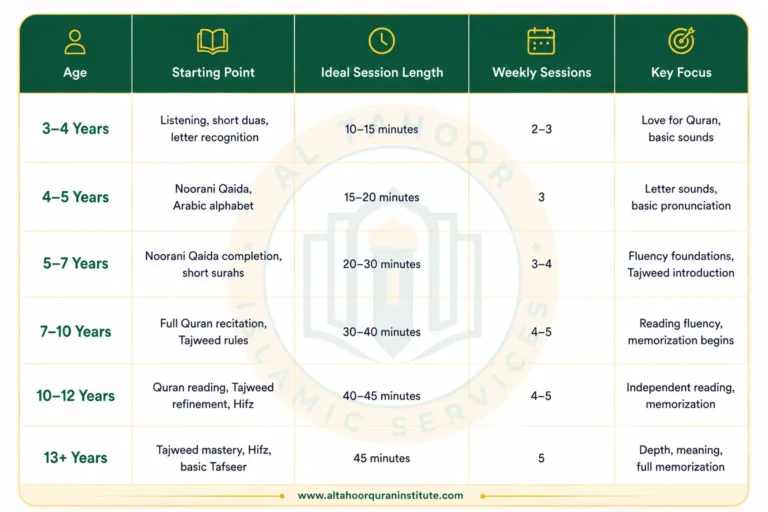
Three to five sessions per week is ideal for recitation and Tajweed. For memorization (Hifz), five to six sessions weekly is recommended. Sessions of 20 to 30 minutes work best for younger children.
Consistency beats intensity. A child who attends three focused sessions every week will outperform a child who attends one long session weekly. Short, regular classes build the repetition that leads to retention.
- Ages 4 to 6: Two to three sessions per week, 15 to 20 minutes each
- Ages 7 to 10: Three to four sessions per week, 25 to 35 minutes each
- Ages 10 and above for Tajweed or recitation: Four to five sessions, 30 to 40 minutes
- Hifz students of any age: Five to six sessions per week, 40 to 45 minutes
Daily practice between sessions is equally important. Even five to ten minutes of self-recitation or revision with a parent each day dramatically accelerates progress.
Common Mistakes Parents Make When Choosing Quran Classes Online for Kids
Even well-intentioned parents can make avoidable errors. Being aware of these mistakes can save your child months of lost progress.
Choosing the Cheapest Option Without Vetting Teachers
Low pricing is sometimes a sign of unqualified teachers or poor curriculum design. The cost of re-learning bad pronunciation habits is far higher than investing in a certified teacher from the start. Prioritize teacher quality over price.
Skipping the Free Trial
Every academy worth enrolling in offers a free trial class. Skipping this step means you cannot assess the teacher’s patience, the platform’s interactivity, or your child’s comfort level before paying.
Ignoring the Curriculum Sequence
Jumping straight to Surah memorization without completing Noorani Qaida leads to incorrect pronunciation that is difficult to correct later. Insist on a program that follows the correct foundational sequence.
Not Involving Your Child in the Decision
Children who feel ownership over their learning are far more consistent. Let your child meet the teacher during the trial, ask questions, and express preferences. A child who chooses to attend is a child who attends.
Expecting Results Without Home Practice
Online classes provide the instruction but not the repetition. Children need short daily practice sessions at home to reinforce what they have learned. Parents play a crucial role in creating this habit.
Step-by-Step: How to Enroll Your Child in Online Quran Classes
The process is simpler than most parents expect. Here is what a typical enrollment journey looks like.
- Research academies using criteria from this guide and shortlist two or three options.
- Visit the academy website and review teacher profiles, curriculum details, and pricing.
- Book a free trial class — most academies require only a name, email, and preferred time.
- Attend the trial session with your child and observe the teacher’s communication style.
- Discuss your child’s current level and goals with the teacher after the trial.
- Choose a plan that matches your weekly schedule and learning objectives.
- Set a consistent home study routine to support lesson content between sessions.
- Review the first progress report after four weeks and adjust frequency if needed.
Start Your Child’s Quran Journey — Book a Free Trial with Al Tahoor
What Makes Al Tahoor Quran Institute a Trusted Choice for Kids’ Online Quran Learning?
Al Tahoor Quran Institute was built with one core purpose: to make Quranic education accessible, authentic, and engaging for children and families worldwide. Here is what sets a quality academy like Al Tahoor apart from generic online platforms.
Certified Teachers Trained for Children
Every teacher at Al Tahoor holds proper Quranic certification and undergoes specific training in child-centered teaching methods. This is not a platform where unvetted freelancers list themselves as tutors. The teachers are selected, trained, and monitored for quality.
Structured Curriculum from Noorani Qaida to Hifz
The curriculum follows the correct pedagogical sequence: Arabic alphabet foundation through Noorani Qaida, then Makharij, then Tajweed rules, then Quran recitation, then memorization. Each stage has clear milestones and assessment points so parents always know where their child stands.
Flexible Scheduling for Global Families
Whether you are based in Pakistan, the United Kingdom, the United States, Canada, or anywhere else, Al Tahoor accommodates your time zone and schedule. Morning, evening, and weekend classes are available across multiple time slots.
Regular Progress Updates for Parents
Parents receive structured progress reports and teacher feedback so the learning process remains transparent. You are never guessing whether your child is moving forward.
Online Quran Classes for Kids in the UK, USA, Canada, and Australia: What Parents Need to Know
Parents raising Muslim children in Western countries face a specific challenge: local Islamic education resources are often limited, inconsistent, or inconveniently located. Online Quran classes solve this problem entirely.
For Families in the United Kingdom
Muslim families in cities like London, Birmingham, Manchester, and Bradford often have access to local madrasas, but the quality varies significantly. Online classes provide access to certified scholars without depending on local availability. Evening slots between 6 PM and 9 PM UK time are widely available from reputable academies.
For Families in the USA and Canada
With large Muslim communities in New York, Houston, Toronto, and Vancouver, demand for structured online Quran classes for kids is high. The time zone challenge is real but easily solved with academies that offer North American slots. Look for programs with dedicated EST, CST, and PST scheduling options.
For Families in Australia
The AEST time zone requires afternoon and evening slots. Reputable international academies now offer dedicated Australian scheduling. Parents in Sydney, Melbourne, and Brisbane have strong options for one-on-one online Quran lessons for their children.
For Families in Pakistan, UAE, Saudi Arabia, and the Gulf
Families in Muslim-majority countries benefit from strong local options but often find online classes more consistent in quality and scheduling. One-on-one online lessons supplement madrasa education effectively, particularly for Tajweed correction and Hifz revision.
Parent’s Quick Checklist Before Enrolling in Any Online Quran Academy
Is the teacher Ijazah or Tajweed certified?
Does the curriculum start with Noorani Qaida or the Arabic alphabet?
Is a free trial class available?
Can I observe my child’s session as a parent?
Are both male and female teacher options available?
Does the academy provide written progress reports?
Is scheduling flexible enough for our time zone and family routine?
Is the online platform safe, private, and user-friendly for children?
Are pricing and cancellation terms transparent?
Does the academy offer a Hifz program if we want to pursue it later?
Your Child’s Quran Journey Starts with the Right Choice
Finding the right online Quran classes for your child is one of the most meaningful investments you will make as a parent. It is not just about learning to recite. It is about building a lifelong relationship with the book of Allah, developing Islamic values from a young age, and creating a daily habit of connection with faith.
The decision framework is clear: start with a free trial, prioritize teacher certification and curriculum structure over cost, choose one-on-one over group for younger children, and make home practice a consistent part of your routine.
At Al Tahoor Quran Institute, every child is matched with a certified teacher who understands both Quranic scholarship and child psychology. The structured curriculum, flexible scheduling, and transparent progress reporting make it easier for parents to stay involved and for children to stay motivated. Book a free trial class today and see the difference a genuinely qualified, child-focused academy makes.
Start Your Child’s Quran Journey — Book a Free Trial with Al Tahoor
People Also Ask: Common Questions About Online Quran Classes for Kids
Can a 4-year-old start online Quran classes?
Yes. Children aged 4 can begin with very short sessions of 10 to 15 minutes focused on Arabic letter recognition and simple duas. The key is an experienced teacher who understands child attention spans at this age.
Is it better to have a male or female Quran teacher for children?
There is no single right answer. Many parents prefer female teachers for young girls for comfort and ease of communication. For boys, both male and female teachers work well. Choose based on your child’s comfort and the teacher’s qualifications.
Can kids do Hifz (Quran memorization) online?
Yes. Many academies offer structured online Hifz programs for children with dedicated memorization sessions, daily revision plans, and Hifz completion certifications. Five to six sessions weekly is the recommended frequency for Hifz students.
What is the best online Quran class for kids?
The best online Quran class for kids is one that combines a certified Tajweed teacher experienced with children, a structured curriculum starting from Noorani Qaida, one-on-one sessions, and flexible scheduling. Al Tahoor Quran Institute offers all of these elements with a free trial class to start.
How do I teach my child Quran online?
Enroll your child in a structured online Quran academy, book a free trial to find a compatible teacher, ensure consistency with three to four sessions per week, and practice together at home for five to ten minutes daily between sessions.
Are online Quran classes safe for children?
Yes, when the academy conducts proper teacher background checks, uses secure private video platforms, and encourages parental observation. Always confirm these safeguards before enrolling your child.
How long is a typical online Quran lesson for a child?
For children aged 4 to 6, sessions of 15 to 20 minutes are ideal. Children aged 7 to 10 benefit from 25 to 35 minute sessions. Older children and Hifz students can handle 40 to 45 minute sessions.