Most Converted Religion in the World: What the Data Actually Shows
People convert to new religions every single day. Some follow a partner into a new faith. Others read a book and find answers they had been searching for years. Some simply walk into a mosque, a church, or a temple and feel something they cannot explain.
But which religion gains the most converts globally? And how reliable is the data? The short answer is this: Islam is consistently cited as the most converted religion in the world, especially in Western countries. But the full picture is more nuanced, and the reasons behind it are deeply human.
This guide walks through the verified statistics, the real reasons people convert, and what global trends tell us about the future of religion worldwide.
What Is the Most Converted Religion in the World?
Islam is widely identified as the religion with the highest conversion rate globally. Multiple studies and demographic analyses point in this direction, though the full story involves both conversions and birth rates.
From 2010 to 2020, Islam grew by 347 million people — more than all other non-Muslim religious groups combined. Source: Pew Research Center, 2025.
In the United States, about 20% of Muslim adults are converts — people who were raised in another religion or none before embracing Islam. That is a conversion share roughly three times higher than the proportion of Christian converts within Christianity, according to Pew Research data.
In the United Kingdom, an estimated 5,000 people convert to Islam every year. Cumulative UK convert estimates exceed 100,000 individuals. France, Germany, and the broader European Union show similar patterns.
It is important to be precise here. The primary driver of Islam’s global growth is not conversion but natural population increase. Muslim women have an average of 2.9 children, the highest fertility rate of any major religious group. Islam’s median age is also among the youngest worldwide, meaning more Muslims are entering child-bearing years simultaneously. The growth is real. Its main engine is demographic, not missionary.
Conversion numbers alone, however, do show a consistent pattern: Islam gains more converts per year in Western countries than it loses. That net positive flow is significant and consistent across multiple decades of data.
World Religions by Conversion Rate: A Full Comparison
To answer which religion has the most converts fairly, you need data across all major faiths. Here is how the major world religions compare on growth, conversion trends, and projected population change.
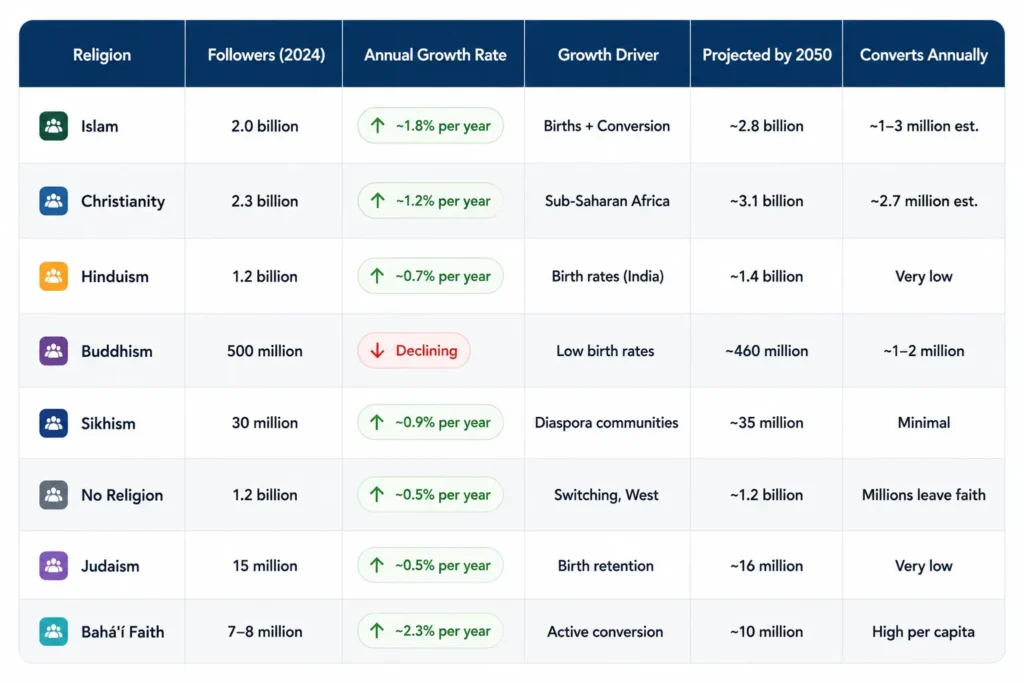
A few key points from this data deserve attention. Christianity has the largest absolute number of annual converts, estimated at around 2.7 million per year globally by the World Christian Encyclopedia. However, Christianity also loses more members through religious switching than any other major faith. For every 5.5 people who join Christianity, approximately 17 leave, according to Pew Research analysis of the 2010-2020 decade.
Islam’s net conversion balance in Western countries is positive: more people convert in than leave. The Bahá’í Faith has the highest per capita conversion rate of any religion but a far smaller base. Buddhism is the only major religion showing a net decline in absolute numbers.
Why Do People Convert to Islam? The Real Reasons Behind the Numbers
Understanding conversion requires going beyond statistics. Research from the USA and UK identifies consistent reasons why people choose Islam.
Monotheism and Theological Clarity
Islam’s doctrine of Tawhid — the absolute oneness of God — resonates with many converts who found other theological frameworks difficult to reconcile intellectually. There are no intermediaries, no concept of a triune God, and no priesthood between the believer and the Divine. Many converts describe this simplicity as the initial intellectual hook that drew them to explore further.
A Pew Research survey found that about 25% of American converts to Islam cited preferring Islam’s beliefs and teachings over those of their prior religion as the primary reason for converting.
Spiritual Discipline and Structure
Islam provides a daily structure through five obligatory prayers (Salah), fasting during Ramadan, charitable giving (Zakat), and pilgrimage (Hajj). Many converts, particularly in Western societies, describe searching for routine, discipline, and purpose before converting. The five daily prayers give converts a rhythm that secular life rarely offers.
Community and Belonging
About 10% of American converts to Islam cite community belonging as a primary motivator. The Muslim community (Ummah) has a notable culture of welcoming new members. Converts frequently describe being embraced, taught, and supported by local mosque communities in ways that surprised them. This sense of immediate belonging is a powerful draw, especially for individuals experiencing isolation or transition.
Intellectual Engagement With the Quran
About 21% of converts to Islam in the USA report that reading Islamic texts and studying the Quran was the primary driver of their conversion. The Quran’s literary depth, its address to reason and reflection, and its comprehensive guidance on daily life are frequently cited by converts who came to Islam through research rather than personal relationships.
Converts Among African Americans
Islam has grown particularly strongly among African American communities in the United States. The historical and political dimensions of African American Islam — rooted in the Nation of Islam, Malcolm X, and the broader civil rights movement — give conversion a cultural and identity dimension that goes beyond theology alone. Islam is currently the fastest growing religion among African American professionals and young adults in the USA.
New to Islam or curious about the Quran?
Al Tahoor Quran Institute offers live one-on-one online Quran classes for beginners, new Muslims, and learners of all levels. Our certified teachers guide you at your own pace with patience and expertise.
Book a FREE Trial ClassIs Islam the Fastest Growing Religion in the World?
The Pew Research Center’s 2025 analysis confirmed that Islam was the world’s fastest-growing major religion from 2010 to 2020. The Muslim population grew by 347 million people in that decade — more than the growth of all other religious groups combined in the same period.
By contrast, the global Christian population grew by 122 million in the same period. Buddhism declined in absolute numbers. Hinduism grew modestly due to Indian birth rates. The unaffiliated category grew in the West but remained stable or declined in much of Asia and Africa.
Some analyses suggest Christianity outpaced Islam in absolute growth between 2015 and 2025 due to rapid expansion in sub-Saharan Africa. The picture depends heavily on the time frame measured and the methodology used. What is consistent across all credible sources is this: Islam and Christianity are growing simultaneously, with different regional engines driving each.
What Will the Religious Landscape Look Like by 2050?
Pew Research projects that by 2050, the number of Muslims globally will nearly equal the number of Christians. By around 2070, if current demographic trends continue, Islam is projected to become the world’s largest religion. This shift is driven almost entirely by demographics — younger populations, higher fertility rates, and geographic concentration in high-birth-rate regions — rather than by conversion rates alone.
- By 2050: Muslims projected at 2.8 billion; Christians at 3.1 billion
- By 2060: Muslims expected to reach approximately 31% of world population
- By 2070: Islam projected to overtake Christianity as the world’s largest religion
- Sub-Saharan Africa will house 40% of the world’s Christians by 2050
- South and Southeast Asia will remain home to over 60% of the world’s Muslims
Most Converted Religion in the USA: What Do the Numbers Say?
The United States presents a particularly interesting case study in religious conversion. About 23% of American Muslim adults are converts, according to Pew Research. That means nearly one in four Muslims in America was not born into the faith.
By comparison, only 6% of American Christians are converts. The conversion flow between Christianity and Islam in the USA currently shows more people moving from Christian backgrounds into Islam than the reverse.
The largest sources of Muslim converts in the USA are former Christians, followed by previously unaffiliated individuals. Most American converts to Islam are women, representing approximately 60 to 70% of converts in several surveys. Many cite Islam’s defined role for women, its emphasis on modesty and dignity, and its clear spiritual framework as primary attractions.
Most Converted Religion in the UK
The UK shows a similar pattern. Islam is the second largest religion in Britain and growing steadily. Approximately 5,000 people convert to Islam in the UK each year. Over 100,000 British-born individuals have converted to Islam cumulatively, according to research from Faith Matters and the Muslim Council of Britain.
British converts are disproportionately white and female. Common conversion pathways include university friendships with Muslim students, interfaith relationships, academic study of Islamic history and theology, and direct engagement with local mosque communities.
Why Do People Leave Religions? The Other Side of the Conversion Story
Understanding the most converted religion requires understanding not just who gains converts but who loses them. The biggest net loser from religious switching globally is Christianity, particularly in Western countries.
According to Pew Research, for every 5.5 people who join Christianity through conversion, approximately 17 leave — predominantly to join the ranks of the religiously unaffiliated. This trend is strongest in Australia (down 20 points in Christian affiliation from 2010 to 2020), Canada (down 14 points), and the USA (down 14 points).
Islam’s conversion balance in Western countries is roughly neutral — people who leave Islam are offset by people who enter. But because Islam’s population is growing so rapidly through births, the relative impact of conversions on overall size is small in either direction.
What Drives People to Convert: Universal Factors Across All Faiths
Research across multiple religious traditions identifies common human motivations behind conversion, regardless of which direction it travels.
- Seeking meaning and purpose: The most common driver across all conversion studies is a search for deeper life meaning that existing beliefs or secular frameworks were not providing.
- Intellectual conviction: Many converts describe a sustained period of research and reading that led to genuine belief rather than cultural conformity.
- Personal relationships: Marriages, close friendships, and family connections introduce people to new faiths through lived experience rather than formal instruction.
- Life transitions: Major life events such as bereavement, illness, divorce, or migration often trigger spiritual searching that leads to conversion.
- Community and belonging: The warmth of a welcoming faith community can be a powerful pull, particularly for individuals experiencing isolation.
- Ethical and justice frameworks: Some converts are drawn to a religion’s approach to social justice, human dignity, and moral clarity on issues their prior worldview left unresolved.
About Al Tahoor Quran Institute
Al Tahoor Quran Institute is a certified online Islamic education academy serving Muslim families, new Muslims, and Quran learners worldwide. Our Ijazah-certified teachers offer live one-on-one classes in Quran recitation, Tajweed, Hifz memorization, Noorani Qaida, Arabic, and Islamic Studies.
For those looking to embrace the faith, we also provide a dedicated service to help individuals convert to Islam online safely, correctly, and with complete guidance.
We serve students across the United States, United Kingdom, Canada, Australia, and throughout the Muslim world. Our program is built for learners at every level, from complete beginners and new Muslims taking their first steps with the Quran, to advanced students pursuing full Hifz.
For anyone who has recently discovered Islam or is exploring the Quran for the first time, our beginner programs provide a gentle, expert-guided entry point. All teachers are patient, qualified, and experienced with learners from diverse faith backgrounds.
What the Most Converted Religion in the World Tells Us
The data consistently points to Islam as the religion with the highest conversion rate in Western countries and as the world’s fastest-growing major faith overall. But the honest picture is more layered than a single headline.
Islam’s global growth is driven primarily by demographics — high birth rates and a young population — rather than mass conversion alone. Christianity remains the world’s largest religion and is growing rapidly in Africa. The religiously unaffiliated are expanding in the West. Every major faith is shifting simultaneously.
What the conversion data does confirm is this: millions of people around the world are actively questioning the beliefs they inherited, searching for something more compelling, and finding it in Islam in numbers that no other religion currently matches in Western contexts. Their reasons are deeply personal: a search for truth, a desire for discipline, an encounter with community, or a book read at just the right moment.
Whether you are searching yourself or simply curious about the world’s religious landscape, the question of faith is never just a statistical one. It is a human one.
Interested in learning more about Islam or starting your Quran journey?
Al Tahoor Quran Institute offers FREE trial classes for beginners and new Muslims with certified, patient teachers. No prior knowledge needed.
Visit to BeginFrequently Asked Questions: Most Converted Religion in the World
What is the most converted religion in the world?
Islam is consistently identified as the religion with the highest net conversion rate in Western countries, with approximately 20 to 25% of Muslims in the USA and UK being converts. Christianity gains more absolute converts globally per year, estimated at around 2.7 million annually, but also loses more through religious switching than any other major faith. In terms of net positive conversion balance in Western contexts, Islam leads. Globally, both Islam and Christianity are growing, driven primarily by birth rates rather than conversion alone.
Is Islam the fastest growing religion in the world?
Yes, according to Pew Research Center’s 2025 analysis, Islam was the world’s fastest-growing major religion from 2010 to 2020, growing by 347 million people in that decade — more than all other religious groups combined. This growth is driven primarily by high birth rates and a young median age, not conversion alone. If current trends continue, Islam is projected to nearly equal Christianity in global population by 2050 and may surpass it around 2070.
How many people convert to Islam every year?
Reliable global estimates are difficult to produce because conversion is a private act and countries record religion differently. Estimates range from approximately 1 to 3 million annual converts to Islam worldwide based on demographic modelling, though Pew Research notes that global conversion rates into Islam are roughly offset by those leaving, making conversions a minor factor in overall Muslim population growth compared to births. In the USA, approximately 100,000 people convert to Islam annually according to some estimates, though this figure is debated.
Which country has the most converts to Islam?
The United States has one of the highest total numbers of Muslim converts among Western nations, with approximately 20% of American Muslims being converts. The UK reports approximately 5,000 conversions to Islam annually. In terms of percentage growth through conversion, Sub-Saharan African countries including Nigeria and Ethiopia show significant conversion activity. Indonesia, Pakistan, India, and Bangladesh have the largest total Muslim populations, but these are driven by birth and historical demographics, not recent conversion.
Why are so many people converting to Islam?
Research from the USA and UK identifies several consistent reasons: Islam’s clear monotheism (Tawhid), which many converts find intellectually satisfying; a structured daily framework of prayer, fasting, and charity that provides purpose; a welcoming community that embraces new members; and engagement with the Quran’s teachings through independent study. About 25% of American converts cite preferring Islam’s beliefs over their prior religion, while 21% say studying Islamic texts was the primary catalyst.
Do more men or women convert to Islam?
In Western countries, women represent approximately 60 to 70% of converts to Islam in most survey data. Common reasons cited by female converts include Islam’s defined role for women, its emphasis on modesty and dignity, its spiritual depth, and the sense of community and sisterhood within Muslim spaces. Men who convert to Islam frequently cite intellectual conviction and the logical simplicity of monotheism as primary drivers.
What percentage of the world is Muslim in 2025?
As of 2025, Muslims represent approximately 25 to 26% of the global population, making Islam the second-largest religion behind Christianity at approximately 28 to 31%. The Muslim population reached approximately 2.0 billion in 2020 and continues to grow at a faster rate than any other major religious group due to higher birth rates and a younger demographic profile. By 2050, Islam is projected to nearly equal Christianity in global followers.
Which religion has the highest retention rate?
Hinduism and Islam typically have the highest retention rates of all major religions, with approximately 80 to 90% of people raised in these faiths remaining in them as adults. Christianity has one of the lower retention rates in Western countries, particularly the USA, Australia, and parts of Europe, where significant numbers of people raised Christian become religiously unaffiliated. Judaism has a relatively high retention rate despite not actively seeking converts.
What is religious switching and how does it affect global religion statistics?
Religious switching refers to an individual changing their religious affiliation from one group to another, including moving to no religion. Pew Research analyzes switching as a distinct variable from birth rates and migration when projecting religious population change. Christianity loses significantly more people through switching than it gains, particularly in Western countries. Islam’s switching balance in the USA and UK is roughly neutral. The unaffiliated category gains the most from switching globally, primarily in the West.
What is the difference between a convert and a revert in Islam?
In Islamic terminology, the word ‘revert’ is preferred over ‘convert’ because Islamic theology holds that all human beings are born in a state of Fitrah — natural spiritual disposition toward monotheism. Someone who adopts Islam is therefore described as reverting to their original nature rather than converting to something new. The term ‘convert’ is used broadly in academic and demographic literature regardless of this theological distinction. Both words describe the same act: formally adopting Islam as one’s religion.
Why does Islam grow faster than Christianity demographically?
According to Pew Research, Muslim women have an average of 2.9 children per woman, the highest fertility rate of any major religious group, compared to 2.6 for Christian women. Islam also has the youngest median age of any major religion at approximately 24 years in 2015, meaning more Muslims are entering child-bearing years simultaneously. These two demographic factors — high fertility and a young population — drive faster Muslim population growth regardless of conversion trends.
What role does the Quran play in Islamic conversion?
The Quran plays a central role in many conversions to Islam. About 21% of American Muslim converts cited studying Islamic texts, primarily the Quran, as the primary driver of their decision. Many describe encountering the Quran’s direct address to the reader’s intellect and conscience as distinctive from other religious scriptures. The Quran’s challenge to the reader to reflect and reason is a frequent entry point for intellectually-driven conversion journeys.
Is Christianity growing or declining globally?
Christianity is growing globally in absolute numbers, driven primarily by rapid expansion in sub-Saharan Africa. As a share of global population, however, Christianity declined from approximately 30.6% in 2010 to 28.8% in 2020 according to Pew Research. The USA, Australia, Canada, and most of Europe are seeing significant declines in Christian affiliation through religious switching to the unaffiliated category. Africa and parts of Asia are partially offsetting these Western losses.
What religion is growing fastest in the United States?
Islam is one of the fastest-growing religions in the United States in terms of percentage growth and the ‘religiously unaffiliated’ category is growing fastest in absolute numbers. The Muslim population in the USA grows by approximately 100,000 people annually through a combination of immigration, birth rates, and conversion. Christianity is declining as a share of the US population, falling from approximately 75% in 2011 to around 60 to 63% by 2023 according to Pew Research and Gallup polling.
Has anyone famous converted to Islam?
Many well-known public figures have converted to Islam across history and in recent decades. Notable American converts include Muhammad Ali (born Cassius Clay), Malcolm X (born Malcolm Little), Cat Stevens who took the name Yusuf Islam, and NBA player Kareem Abdul-Jabbar. In the UK, former journalist Yvonne Ridley is among notable converts. Each public conversion often generates significant media attention and can influence broader awareness of Islam in Western countries.
Does Al Tahoor Quran Institute accept students who are new to Islam?
Yes, Al Tahoor Quran Institute welcomes new Muslims, reverts, and complete beginners with no prior knowledge of Arabic or the Quran. The beginner program starts with Arabic letter recognition through Noorani Qaida before progressing to Quran reading. Teachers are experienced in working with learners from non-Muslim backgrounds and approach every session with patience and understanding. A free trial class allows new students to assess the teaching style before committing.
Can someone who just converted to Islam learn Quran online at Al Tahoor?
Yes, Al Tahoor Quran Institute is specifically equipped to support new converts and reverts in their early Quran learning journey. The beginner curriculum requires no prior knowledge of Arabic, Islam, or Quran recitation. Teachers start from the absolute foundation: Arabic letters and their sounds. Many of Al Tahoor’s students across the USA, UK, and Canada are individuals who came to Islam as adults and sought structured Quran education online.
Does Al Tahoor Quran Institute offer Islamic Studies for people learning about Islam for the first time?
Yes, Al Tahoor Quran Institute offers Islamic Studies courses suitable for beginners and those newly interested in Islam. Topics covered include basic Islamic beliefs (Aqeedah), acts of worship (Ibadah), Prophetic biography (Seerah), and Quranic ethics. Classes are delivered in plain English by teachers who are skilled at explaining Islamic concepts to learners from non-Muslim backgrounds without assumed prior knowledge.